Tag Archives: Zuni

Unlikely, Wonderful

We had come down off the mesa capstone, down a draw onto a hidden level. There were axe-cut junipers, a few chert flakes. Suddenly my companion gave a shout: On an anthill at the mesa edge, he had found a tiny crumb of turquoise.

It was the true-blue thing. Unworked, totally out of place on the sandstone. Who had dropped it, and when? A Navajo trader-silversmith? But we’d seen none of the stone circles that are the foundations of old hogans.

Or was it an offering? Contemporary Zunis mix bits of turquoise into the white cornmeal, k’aweawe, that is used for blessing, That remote mesa edge, now the middle of nowhere, was distant from Zuni in both space and time, but for thousands of years it had been the middle of a lively somewhere. Had someone once stood there on the east-facing mesa rim, sprinkling cornmeal for the morning prayer? 

No way to know. We said elakwah—“thank you” in Zuni—and left the turquoise with its ants.
Many Manos

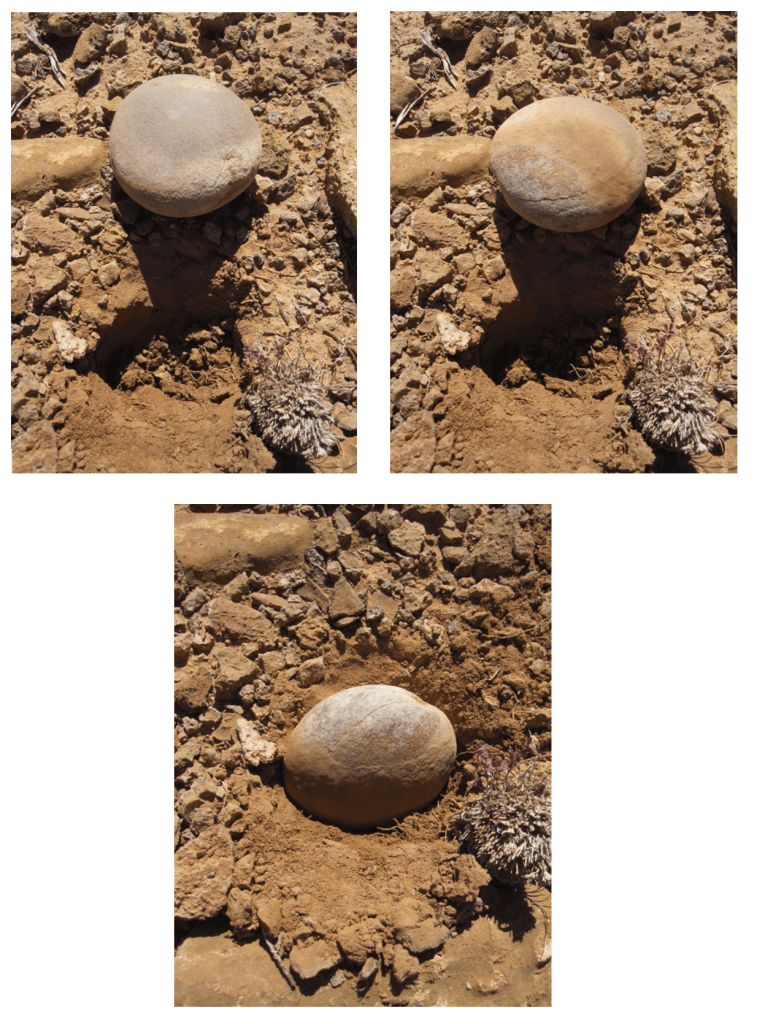
All day we spotted Archaic manos, grinding stones, whole or broken–this in terrain we’d hiked for decades. What was it about today?

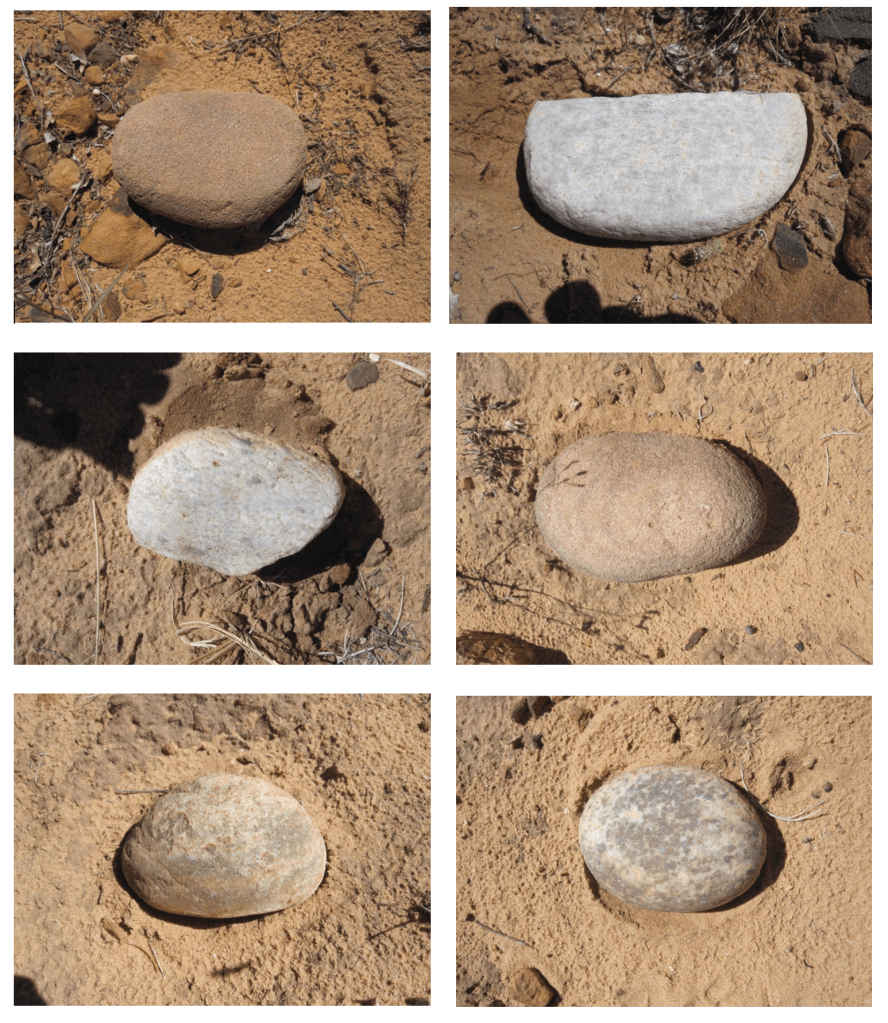
First mano. Front elevation, rear elevation, then back into its nest for the next few thousand years:

More manos: Some were carefully shaped. Some were an expedient cobble, one or both sides slicked by use on a handy flat rock as metate.

Unlike more recent, Puebloan manos, which were flat and wide for grinding corn, Archaic manos–thousands of years old–were a characteristic oval. Mostly they were used to grind wild seeds: Indian rice grass, for example. Or whatever edibles the desert had to offer. A friend in Zuni said of his wild-resourceful grandmother, “Grandma eats everything.

Two Joys

Two-track and Red Star, Betsy James

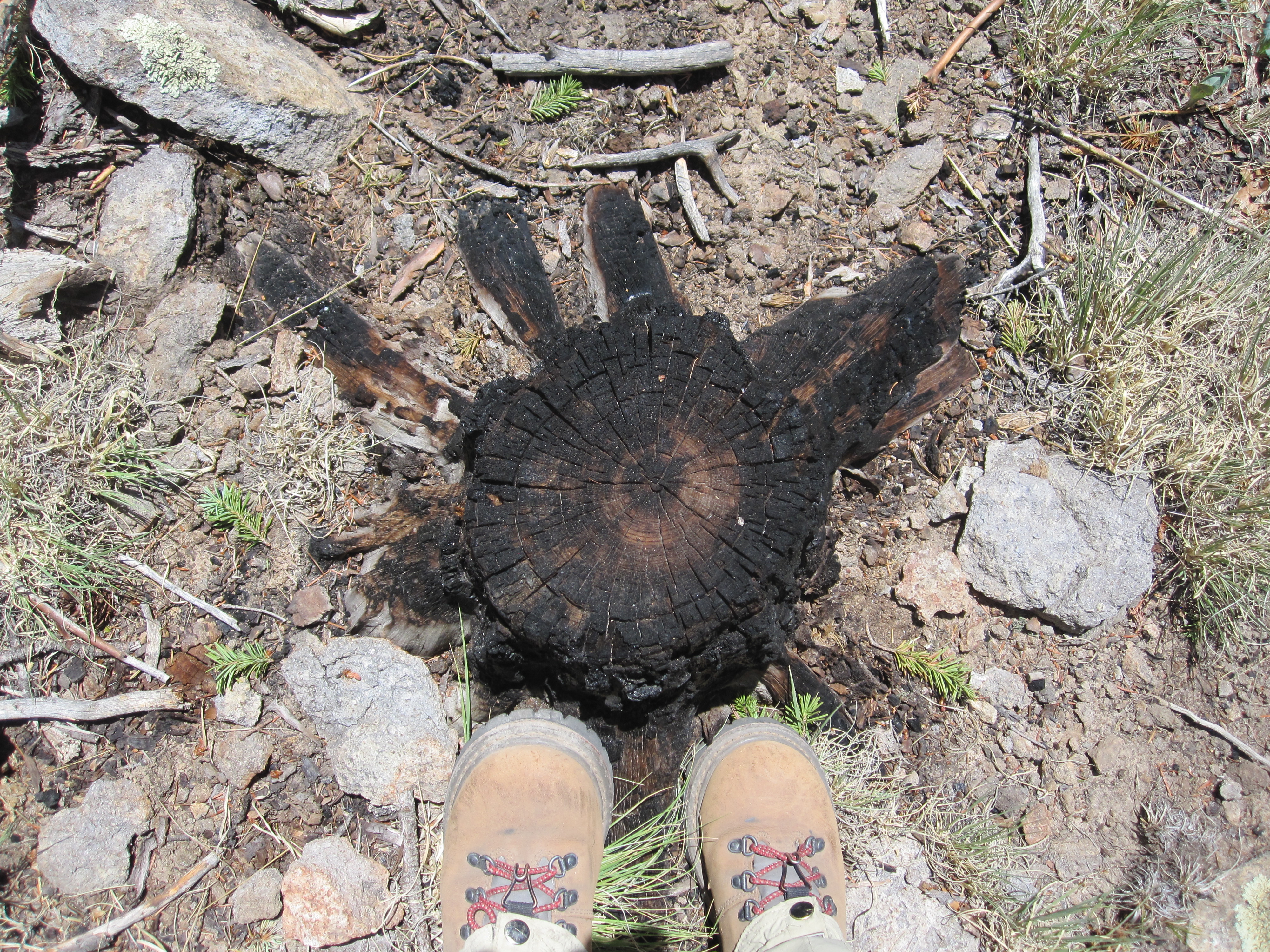
One: two-tracks, the dusty, lonely roads that follow the contours of the West. The one above reminds me of a long-ago hike taken from the low road to Zuni.

Two: hiking high and wild, to beat the heat and get up where breathing is a pleasure. Lately that has meant the Jemez Mountains, raked over by wildfires but springing up green with the monsoon rains. We just missed the wild raspberries: the bears got there first.

La Plus Ça Change

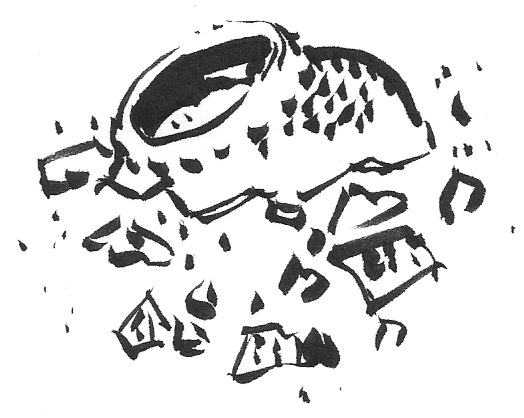
Smashed PotAs we walked a low ridge we came upon a mystery: a dozen square feet of desert pavement formed by gray Archaic potshards and eleven fragments of chert knives, none from the same knife.

Patricia said: Nah, no mystery. Some Archaic woman, PMS-ing, had busted her eight pots and eleven knives, hollering, “I’ve had it! Mend your own damn loincloth!”

No trace of habitation. Had we stumbled on a sacrificial place, where pots and knives were broken to send their spirits onward with the dead? Was it the site of a solstice ritual like Zuni’s, when pots were smashed? As a theory I like Paleo PMS.

Here, Kitty, Kitty

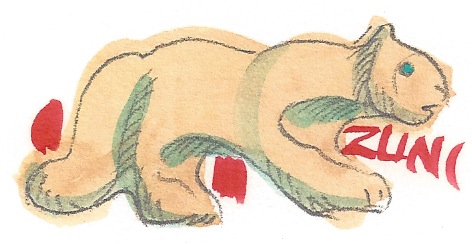
Mountain Lion FetishWhere we hiked Jan had found many mountain lion tracks. I learned that lions focus on small animals: I’m 4’11”. Small animals with high voices, actually. I dropped my usual backcountry shout by a good octave.

In Zuni the lion’s name is hokdidasha. Hokdidasha is—I think, but what do I know?—the beast priest of the north. The fetish shown is unsigned.

No Doubt

At Zuni: We borrowed a clutch of neighbor kids and went hiking in the windblown sand south of the pueblo. The kids were itchy and wild, flinging themselves off the red dunes, playing cowboys and Indians—funny, given that they were all Indians.

One of the adults, a fast hiker, disappeared for awhile. We wondered aloud, “Where’s Andy?” Small Brandon said seriously, “Prob’ly those Indians got him.”

*

Eagle Mother


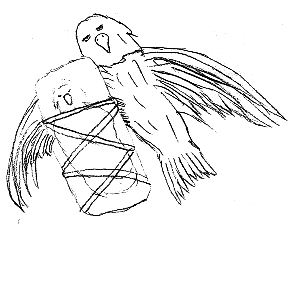
At Zuni Pueblo, a storymaking workshop for 3rd, 4th, 5th graders. Writers can’t be restrained from doodling while they think, so we covered the new library tabletops with yellow butcher paper. When we cleaned up on Friday—the kids long gone—among the smudgy misspellings and graffiti was  this drawing, unsigned.

Her quiet face.

*

Straight to Heaven


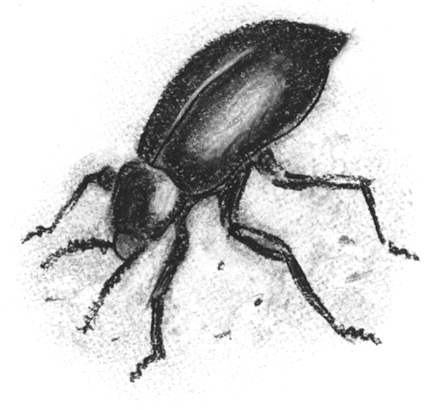
In Zuni, if I have it right (and often I don’t), you go through several incarnations after this human one. The first are as food-giving game animals like deer or antelope. But the last—right before you go to heaven to dance for eternity—is as sho:mi:do’kya, the little black stinkbug that raises its tail on our desert’s red earth.

I once had a stinkbug crawl into my old Intellifax 1270 and die there. This caused a paper jam and permanent scratches on the drum, but I felt kind of touched that somebody went to heaven from my fax machine.

*

LLs Across the Water


In the mid-nineteenth century, Stephen James emigrated from Wales to work as a shipbuilder on the Great Lakes. Though he didn’t know his great-great-granddaughter would one day teach at Zuni Pueblo, he bequeathed to her the legacy of the unvoiced, or aspirated, L.

Llewellyn. Llangollen. The tongue forms an L, but the vocal cords rest and let the breath take over. English-speakers struggle, but Zuni-speakers are right at home with Grandpa’s double L.

Me’shoko eshe llabissho.

It means “donkey lips.” If you can say it, you’re Zuni…or Welsh.

*