All posts by Betsy James

Tooth of Time


To the western breaks. Our aim was to look for green agatized wood, but we hiked all over the place.

There were fragments of bone scattered through the arroyos—even part of a jaw, you could see the tooth sockets. At the base of the cliffs I spotted broken antlers, picked them up…and they were stone. I examined them with a hand lens and found, on one, the tiny, parallel, transverse scars left by the incisors of a Pliocene mouse or vole.

Those delicate tooth marks are slightly over two million years old.

*

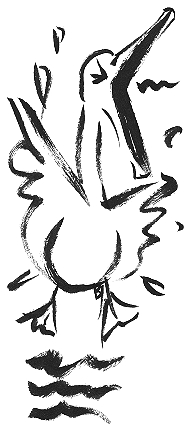
Duck!


A fast trip to the muddy roads of Zuni Pueblo, to admire this year’s babies and exclaim over how big last year’s have grown. There’d been lots of snow; it was so wet, they warned us, that the Navajos were parking on the pavement.

That’s wet.

I learned to say “quack” in Zuni: naknak’ya. The apostrophe is a glottal stop, the tiny pause in Uh-oh! (which in Zuni would be spelled Uh’oh!).

The past tense of naknak’ya is naknak’yakkya. The happy clamor of ducks on a pond: Zuni nails it.

*

Writing Fantasy: Imaginary Slang 2


How do aliens swear?

Not just aliens but all speakers of imaginary languages. Think about it. A polytheist who says “My god!” means something quite different than does a monotheist—and wouldn’t capitalize.

In Listening at the Gate I needed an epithet for use by Nondany, the itinerant master folklore collector. I settled on “By life!” I like it so much I want to get a slang wave going.

Recently  a librarian nailed me with a steel eye and asked whether there was any “bad language” in the novel. I explained that it took place in an imaginary culture, but since all cultures have profanity, I’d had to invent some. She looked baffled. And bought the book.

Writing Fantasy: Imaginary Slang 1


You’ve evoked an imaginary world. You want the speech of its denizens to sound human and true…but if you use contemporary slang the Norns sound like Valley Girls. What now?

Here’s a solution:

*

*

…..“It hums so loud, Kat. I can’t not hear it.”
…..“Is—is it death?”
…..“It’s greater than death.”
…..I tried to think of something greater than death, and could not.

……………………………Listening at the Gate

*

In dialogue, the speakers use contractions: can’t, it’s. But the in the text of the book proper, the matrix, words are spelled out in full: could not.

Subtle. Simple. And it works.

*

Honey in the Rock


On archaeological field survey: way to hellandgone New Mexico, thirty miles of washboard dirt road on land so overgrazed it was “cow burnt.” A cold day.

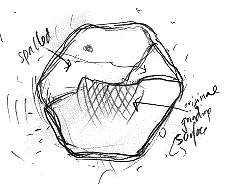
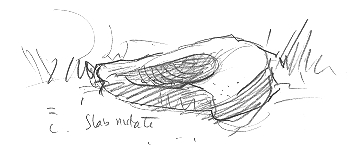
A wide, empty valley fissured by new erosion, arroyos thirty feet deep. On a low volcanic promontory, the scattered stones of an Archaic site like tossed newspapers in a messy room. There was a “kitchen”—a cluster of sandstone slabs—and in the middle of them was a worn grinding stone, a metate.

It was hexagonal. None of us had seen that before. Archaic, therefore thousands of years old—but hexagonal?

In this desert land, wild honeycomb would have been almost the only sweetness.

How do you say “Way too many”?

In the Mexican state of Oaxaca, thirteen indigenous languages are spoken. (This in addition to Spanish.)

In Oaxaca city, working with a group of preschool teachers who were making handmade readers for their students, we posed a question: How, in your various languages, would you express quantity: words like “lots,” “a few,” “some,” “a bunch”?

They grinned and asked us back: What are you referring to? Because in our languages it depends whether you’re talking about a lot/few/some/bunch of:

Long, skinny objects

Round objects

Animals

Fingers

Stuff that is neither close nor far away

Things we used to have

Things we might have someday

and so on.

I was humbled. Until then I had felt smug about the precision of my prose.

*

For more on Teaching and Speaking, click here.

Why Speculative Fiction?

“If you ask: Why spend time on a writer of escape literature? please consider for a moment the position that the literature of fantasy and science fiction provides more direct functional access to reality than any other modern work of the intellect. When experience is rendered ineffable by a rate of change that undermines the meanings of language, a literature that has evolved to speak out from the middle of the waterfall of ideas can continue to engage and to convey the most important meanings. And this is not a new discovery. The oldest roots and origins of literature, the epics of Gilgamesh and Innana, the Odyssey, the Iliad, all are either fantasy, if you do not believe in the Gods, or science fiction, if you do.”

Margot Adler, Heretic’s Heart: A Journey Through Spirit and Revolution

For more on Speculative Fiction, click here.

Homestead Canyon

To Homestead Canyon in the Cebolla Wilderness. A glittery fall day.

At the wilderness boundary hunters had driven off-road, broken down the fence, and taken a truck in. We parked and sloped off on foot through prickly year-end weeds; my socks are full of stickers.

On the mesa top are the stone-heap remains of little pueblo. (The area was heavily settled in the 1300s.) On one sandy ridge the wind had exposed the four yellow-and-red sandstone slabs that made the half-moon edge of a storage cist. The whole ridge was sand-scoured, ventifacted, all wind-worn surface.

Nearby, also wind-scoured, were the sparkly bits of a metate (grinding basin), Archaic and thus hundreds of years older than the pueblos, that had been ground clear through with use. Human stories, one on top of another.

The piñon nuts were ripe and falling out of the cones. We kept stopping to eat.

Winterfat had the low winter light behind it, blazing silver. Spider guy wires were strung juniper to juniper; we broke those fine, elastic barriers as we walked.

*

For more walks on stone and sand, click here.

Cañoncito

To Cañoncito. A fiercely windy day. My ears, teeth, hair are full of grit.

The harsh, huge wind. Immense peace.

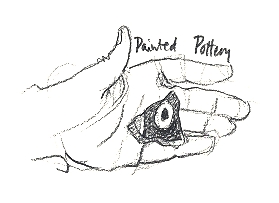
The day was spent in classic hunter-gatherer country: piñon, sandy hills, sandy bowls and corries, the burned earth that marks Archaic sites. I came upon fragments of a smashed Puebloan bowl that had been painted with stripes and checks, still sitting right where it broke. Right next to the bits was a tidy burned spot, quite round, perhaps twelve inches in diameter: the fire at which the bowl had broken. Growing exactly out of the center of the burned spot, happy for the nitrogen, was an eight-inch cedar trunk.

Mountain bluebirds, light-bellied in the wind, reminded me of fish swimming in the sea.

*

For more walks on stone and sand, click here.