All posts by Betsy James

Ojito in October

To the Ojito Wilderness with a motley crew of desert-rat friends.

Windy. Took shorts, but it was too cold to wear them. We drove way far out in the Ojito and hiked down to the place where there’s scattered white-yellow-green petrified wood, below hoodoos among the ponderosas.

Archaic firepits. The crew kept getting ahead of me; I was dogging back and forth, trying to keep them in sight, now and then frantic as the others got farther and farther away and I had to run after them.

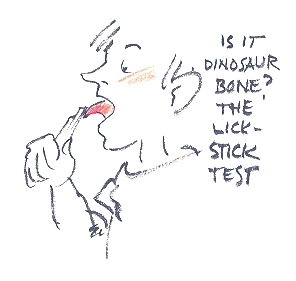
Found a large dinosaur bone on the ridge by following its fragments up a wash. It was falling apart; we dug some of the sand away from it, then covered it back up without ever having located both ends. Jan taught us the lick-stick test: If it’s bone, rather than another type of rock like agate or petrified wood, it will stick to your tongue when you lick it. (The porous vesicles left by cells and capillaries wick up the moisture of your tongue.)

Windblown grass draws circles in sand, as in snow.

Oak bushes have brown leaves around their bases, bare grey twigs on top.

Back in Bernalillo we went to Silva’s Saloon, which was full of bikers in leathers, a billiards game in progress. We shared two pitchers, ate Kentucky Flocked chicken and came home happy.

I forgot to say that on an Archaic site on the ridgetop was a broken mano, a hand-grinding stone: pretty, crystalline, red and white and yellow, with a slanted natural edge of white quartzite along one side. The edge made a perfect place for the user of the stone, probably a teenager, to hook her fingers. So I hooked my own fingers there, thinking: After five thousand years–fifty centuries–this stone remembers the grip of a hand.

*
For more walks on stone and sand, click here.

Balancing Writing and Art

My family was anxious about labels. (“What’s your major?”)

To my ancestors—who according to the Zunis are dancing for eternity, though it’s hard to envision those inveterate Presbyterians dancing at all—I say: What I am is me. I am the one who writes, paints, works, sings…and dances.

How to do it all—time allocation—is another question. Honest, guys, I don’t know how. I dither and fiddle and get cranky. I put in a good work day, but sometimes that means lying in the grass staring at clouds, or walking around an Asian store trying to guess what the hell some dried object is.

I try to distinguish my family’s slightly hysterical work-ethic voice from the deep, driving voice of what actually wants to get done. Sometimes one is louder, sometimes the other. But as I accept my own mortality I have less patience for the hysterical voice. More and more I cleave to the voice of time, nature, peace: the voice of earth, where we are one of the gang: very unimportant, very much a part of the world.

For more on the double life, click here.

For walks on this earth, click here.

Being Both

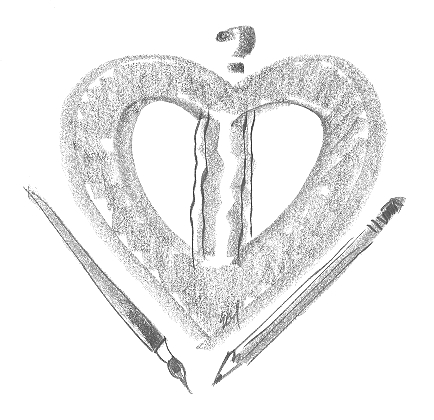
Who am I? A writer or an illustrator? Which? Both?

Yikes.

For years I drove myself insane with that question. Sometimes quite theatrically. “Is there a name for somebody who isn’t just an artist and isn’t just a writer but is something that doesn’t really have a name? How do I tell people what I ‘do’? What am I?

Many a 2 a.m. distress session there. Until a friend clarified things.

He said, “Your nouns are fighting each other: artist vs. writer. If you used verbs instead—I’m painting or I’m writing—then it’s just a question of time allocation.”

Duh!

For more on leading a double life, click here.

Mysteries of Educational Illustration

One would think that if “Show a child deciding it is unwise to stick a pickle fork in a light socket” is considered a spot illustration, then more cash and elbow room might be offered for “Show thirteen multi-ethnic children, two of them in wheel chairs, with their multi-species pets, deciding by concensus not to stage Chinese New Year (with dragon) on a transformer.”

Interestingly, this is not always the case.

*

For more on educational illustration and its antidote, click here.

Three Systems

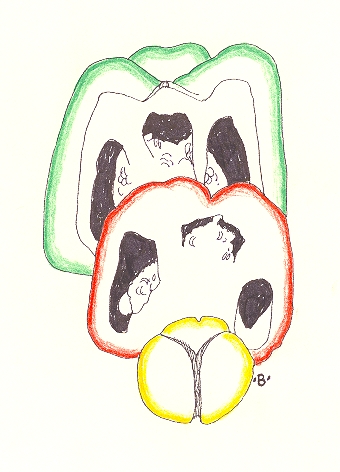
Daybook drawing: Peppers

We writer-artists—those in the arts in general—have interesting stuff happening in our brains. Which is why we can do the cool stuff we do…and why we can’t speak coherently when, in the middle of a paragraph or a painting, we have to pick up the phone.

And why we’re so often late bloomers. Most people have to learn only one system—the culture they were born into—but an artist must learn two: the culture they were born into, and their own idiosyncratic brain/psyche. They must then, on their own, invent a third: a system which, like a bilingual ambassador or a car’s transmission (choose your metaphor), mediates between the first two.

No wonder it takes a while to sort it out. If you’re in a creative calling, or working your way into one, be patient with yourself. You’re inventing a new world.

For more on creative process, click here.