Tag Archives: hiking in the desert
Reality, Comma, Various Aspects of
We followed the water-scoured sandstone channels until they petered out, then crossed to the next gully west. This ended in a series of tinajas and a plunge pool. We crawled up to a rock shelter above—charcoal and sherds and rat poop—and clambered down to a second, even lovelier set of pools. There we put our backs against the stone and listened to the ponderosa sigh. Most beautiful tree, the ponderosa. Most beautiful voice, the peaceful tree.
In the midst of this communion with nature G. discovered that a thermos of coffee—cream and sugar—had come open in his pack.
Hidden Honey
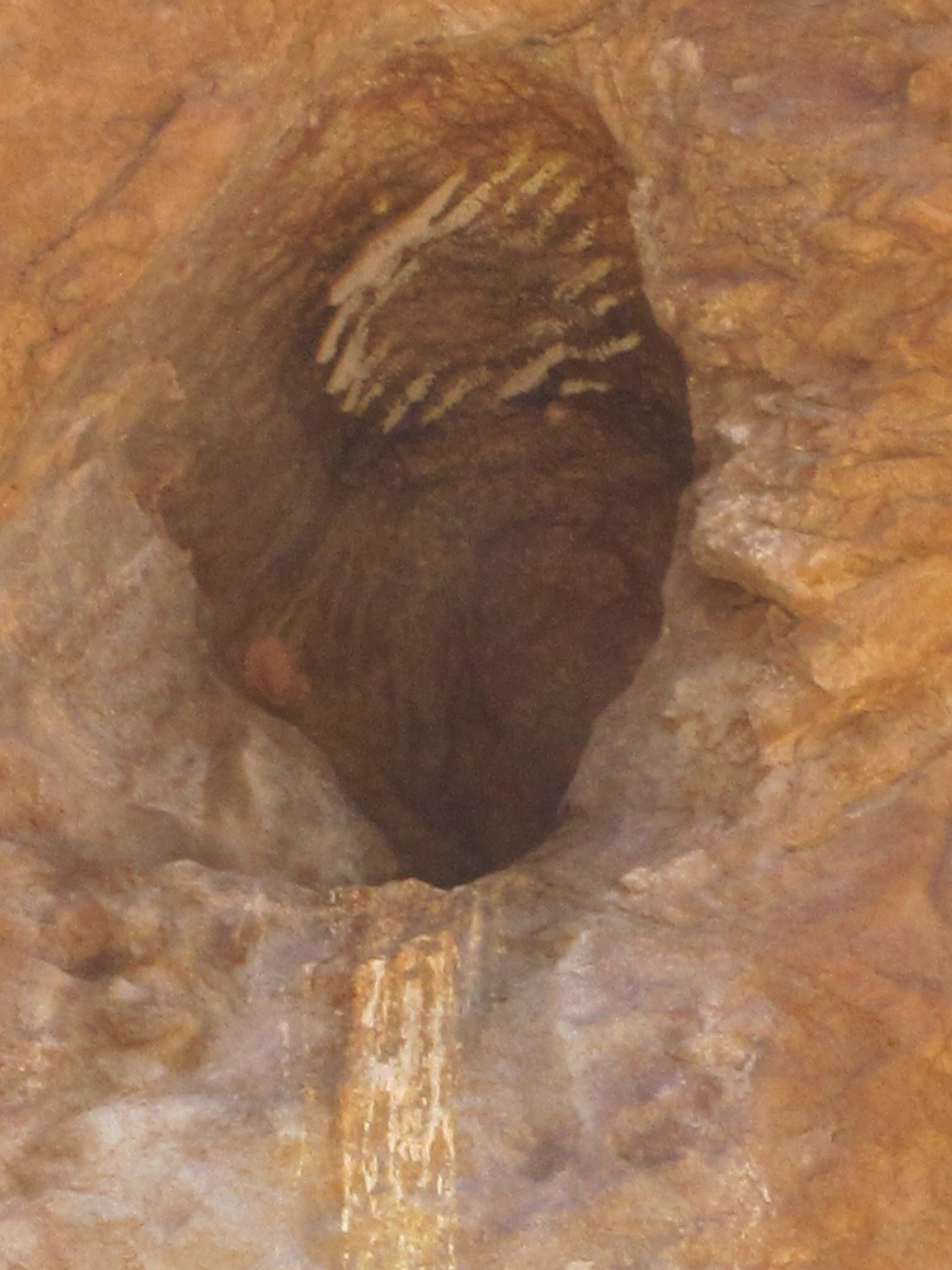
The dry stream bed we followed left the sandstone and entered a twisted granite canyon, narrow and deep-shaded. A barn owl startled and flew, soft clop of wings. High on the canyonside was its nest hole, the entryway streaked with mutes. Striations on the roof of it were the weathered wattles of a wild beehive, the remaining honey cells like waxy lace.
That hive was abandoned. But when we dug at a damp place in the sand, water welled up and thirsty bees came clustering. Somewhere in that canyon there is a hidden hive.
Visions
From the western ridge of the syncline a pass looks out over Cabezón, shadowy and shadow-washed. Many ancient, rudimentary stone circles scatter their boulders on high points. Each may be the site of a vision quest; we can think of no other explanation. Below lie mineral springs. One is raised on its deposits, a breast whose nipple is a pool, perfectly round, green as an old penny.
As we walked back along the ridge, some small creature far down among the split rocks screamed at us: Squee! Squee! Squee! An ear-splitting insult that never stopped until we went away.
Local
The spareness of the desert: a small hill was home to seven clumps of terra cotta-pink grass. Beyond it, dark piñones echoed their humped shape. All carefully spaced; plants form a community, yet they’re individuals who live with each other at a social distance.
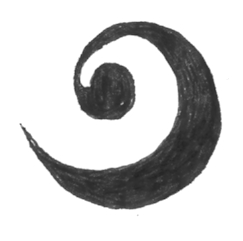
I drew the fossil of a spiral snail shell embedded in a gray limestone boulder.
*
*
Time. Time.
Rambling in a rubbly, lunar, black-and-tan landscape where nothing grows but saltbush. Water-scoured sediments, here and there a hunk of dinosaur bone, and hundreds of stones so polished they might have been tipped from a rock tumbler. John, the geologist, says they’re gastroliths: dinosaur gizzard stones.
“Swallowed by dinosaurs as they traveled their migration routes,” he said. “Maybe hundreds of miles long. None is bigger than a grapefruit; if they were the result of normal deposition they’d be more varied in size, with no upper limit. And they’re all exotics, not from any source near here.”
“Then where are they from?”
He said, “The mountain range they came from has long since worn away.”
*
Ow!
The first cactus: I hopped the fence onto the Malpais, and with my first step ran into a cholla. Guess I haven’t been hiking for a while.
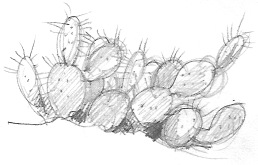
The second cactus: side-hilling down from the sandstone ledges, I slipped on the scree and my right hand, which I put out instinctively to catch myself, landed smack in a prickly pear. Stabbed full of big spines, furred with gloccids. I had to stand where I was and pull the spines out; got most of them, but a few I’ll bear to my grave like shrapnel.
*
Strange Place, Our Home Planet
Here, Kitty, Kitty
Where we hiked Jan had found many mountain lion tracks. I learned that lions focus on small animals: I’m 4’11”. Small animals with high voices, actually. I dropped my usual backcountry shout by a good octave.
In Zuni the lion’s name is hokdidasha. Hokdidasha is—I think, but what do I know?—the beast priest of the north. The fetish shown is unsigned.