My mother was a teacher. I spent a long time avoiding that calling.
Then a cherished friend, Ken Hause—curriculum designer for Outward Bound and longtime teacher of mathematics and Eastern thought—said to me, “Teaching has to do with the soul of the teacher.”
A day both cool and warm. Hazy clouds, pumice sand underfoot, soft wind hushing in the ponderosa. The water of Peralta Creek was icy with runoff, milky with pumice dust.
We bushwhacked up a box canyon full of oak brush and wild roses; I bled furiously. Strong smell of skunk or weasel. A swallowtail butterfly in erratic flight, bright yellow among the worn boulders.
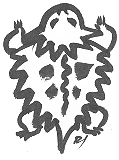
Caught the first horned toad of the year: a fat one, with salmon belly and yellow side-fringe. About the size and heft of an Oreo cookie.
As we rumbled down a dirt track south of Zuni, a young eagle burst from the roadside chamisa. Rising, it dropped the limp body of a rabbit, then circled through the hosting ravens and repossessed it.
We started a half dozen antelope, who paced the truck to 25 mph. When we slowed they burst ahead, clearly racing us.
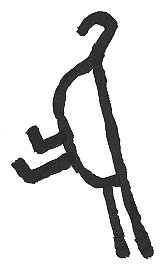
Long wandering on foot brought us to a wide, quiet ravine whose walls were covered with petroglyphs: many macaws, prehistorically revered and carried on foot from Mexico. Only bushtits there now, whispering in flocks. I started a big jackrabbit; as it zipped under the brush it folded back its ears, the way a cherrypicker folds to fit under a freeway bridge.
Even when I don’t want to write, if I begin, the flow begins: very steady, like blood, or a river.
Year after year I hiked down Frijoles Canyon to the Rio Grande. The river is always there. In different seasons it is different colors—tan in March, emerald in October—and has different water levels, and the sky above changes color and temperature.
Throughout the desert West, the backcountry hiker finds “sheepherders’ monuments”: cairns or slabs of stone raised by turn-of-the-century herdsmen while their sheep grazed, day after day, in the wide silence.
On a hillside of small-grain, gray, dissolving shale we came upon a slab of white sandstone, set on end like a tombstone and blocked up all around with dark rocks. Prickly pear had grown in among the stones.
We’d hiked there a dozen times and never seen it. The desert is like that: bare and open, yet turn your head and there’ll be something that’s been looking at the sun for a hundred, or a hundred million, years.
Zuni: The kindergartners are dictating (and I’m illustrating) their story about a baby mouse carried away from her parents on a kite. I ask them, “What would her parents do?”
Abigail, five, mimes the mouse’s father: Scowling, fists on hips, she shouts, “Get down off that sky!”
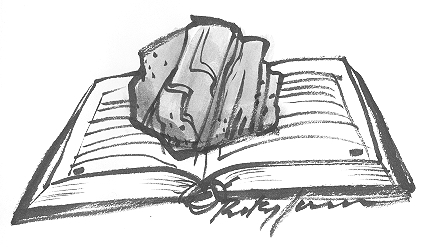
We all have too many books. But I have books and rocks.
I have best rocks; second best rocks; third best rocks; and driveway rocks, which I don’t care if somebody steals. When I move, the best, second best, and third best go with me.
Last time I moved, my brother tried to lift a box before he noticed it had been labeled (neatly) ROCKS AND LEG WEIGHTS.
So why, he asked, nursing his lower back, couldn’t you have packed ROCKS with PILLOWS? ROCKS with UNDERWEAR?
Hey. I could have packed them with The Shorter Oxford English Dictionary.
To the western breaks. Our aim was to look for green agatized wood, but we hiked all over the place.
There were fragments of bone scattered through the arroyos—even part of a jaw, you could see the tooth sockets. At the base of the cliffs I spotted broken antlers, picked them up…and they were stone. I examined them with a hand lens and found, on one, the tiny, parallel, transverse scars left by the incisors of a Pliocene mouse or vole.
Those delicate tooth marks are slightly over two million years old.

 My mother was a teacher. I spent a long time avoiding that calling.