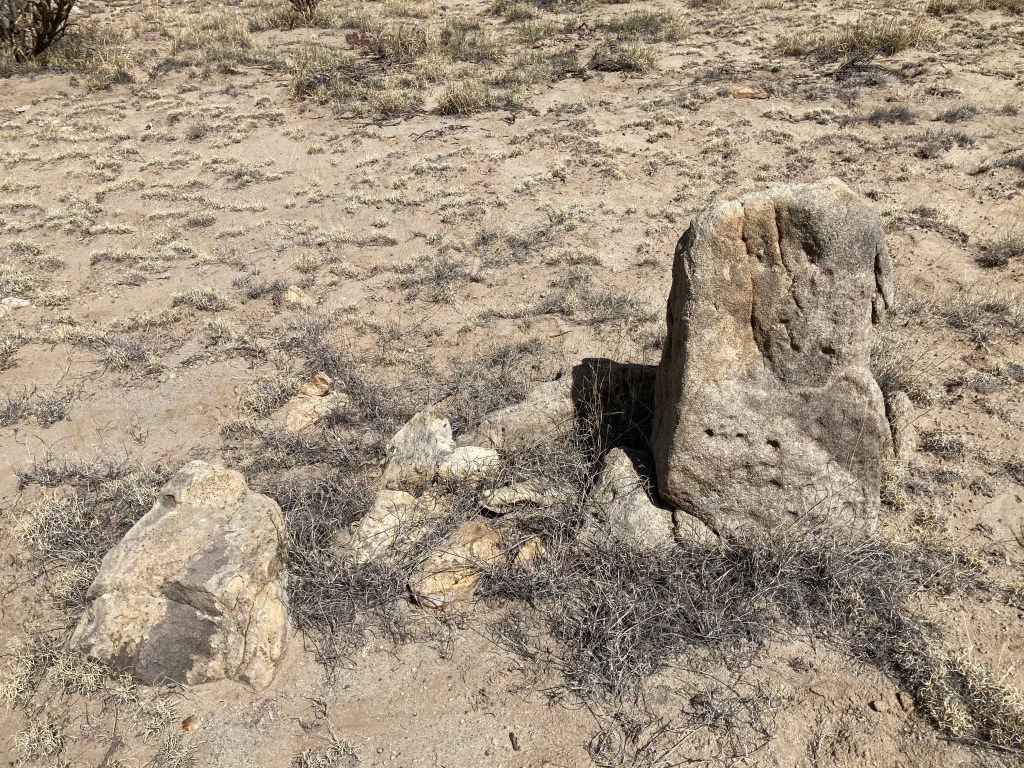
It stands in the middle of one of the linked plazas of a remote, dusty, fallen Pueblo complex that was abandoned, probably because of drought, sometime about 1200 C.E..
It’s not a grave. Ancestral Puebloans didn’t do graves with headstones.
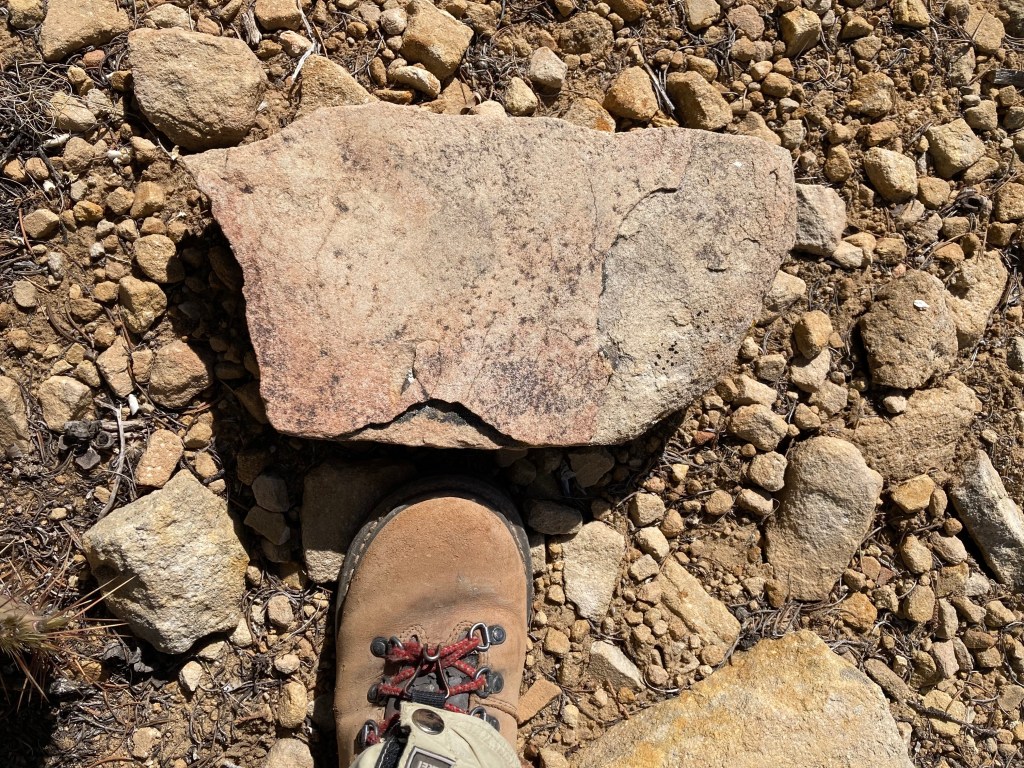
It looks shrine-ish. The unassuming shrines of the Pueblos are often a careful pile of stones.
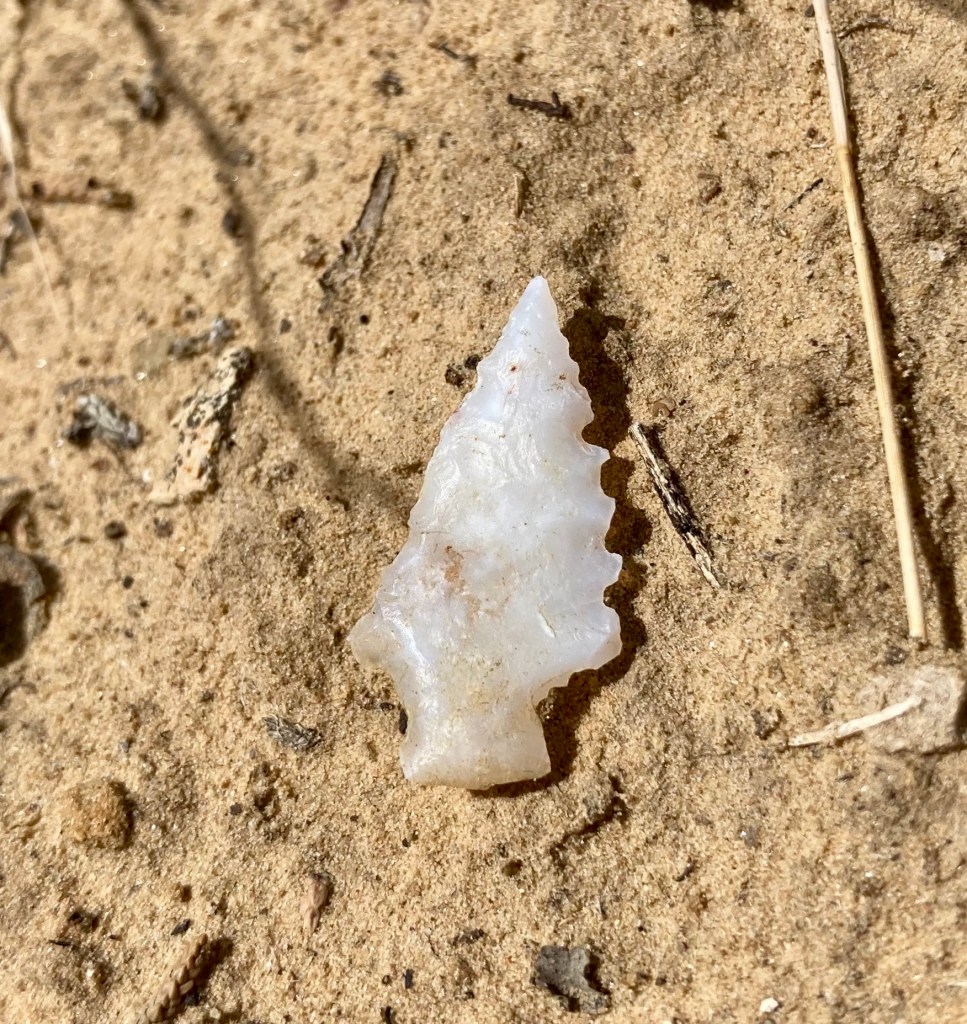
I’m not great at identifying projectile points, but my best guess is that this is an Armijo point (Late Archaic, about 2,000 B.C.) and an atlatl point rather than an arrowhead. It was about an inch long, and, interestingly, had had a “field repair.” The original delicate serration had broken along one edge, spoiling its symmetry, and someone–the original owner? a later finder?– had resharpened the broken side with plain bifacial knapping. Like a slightly tippy Christmas tree, it looks wonky but serviceable.
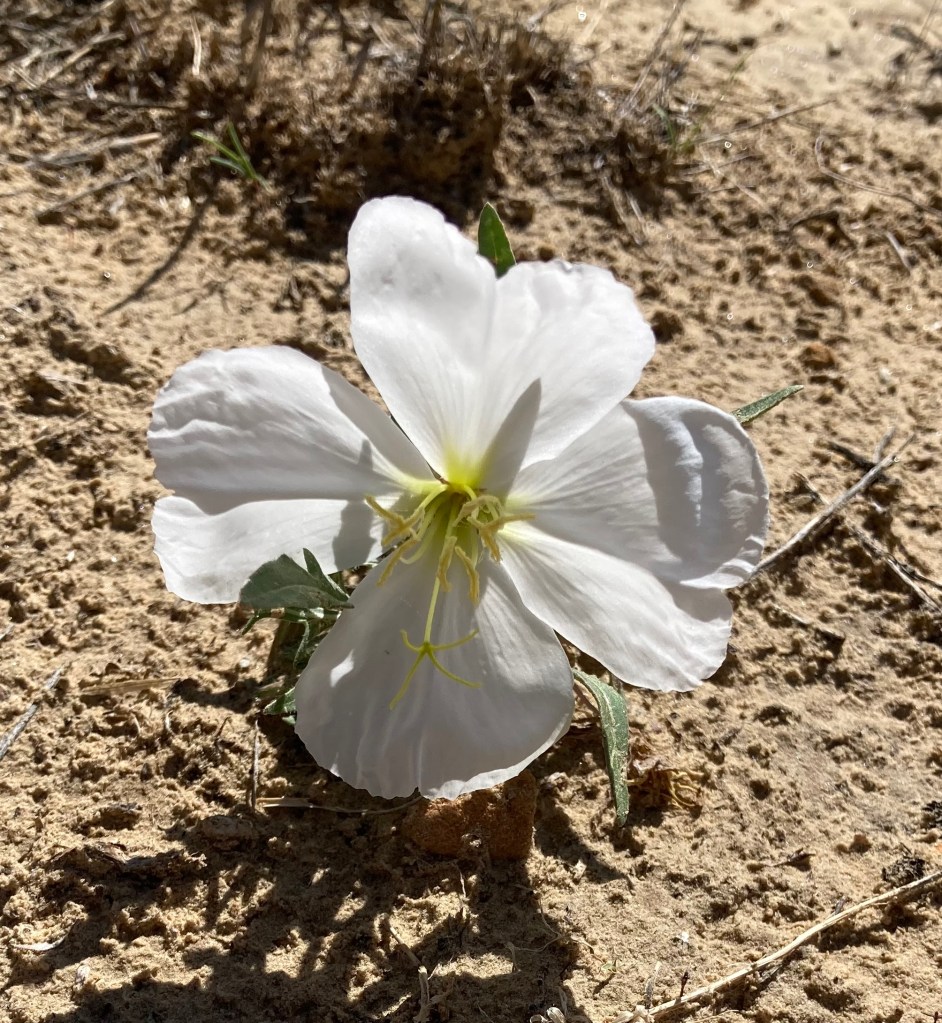
I’m not great at identifying flowers, either. But the desert was blooming.
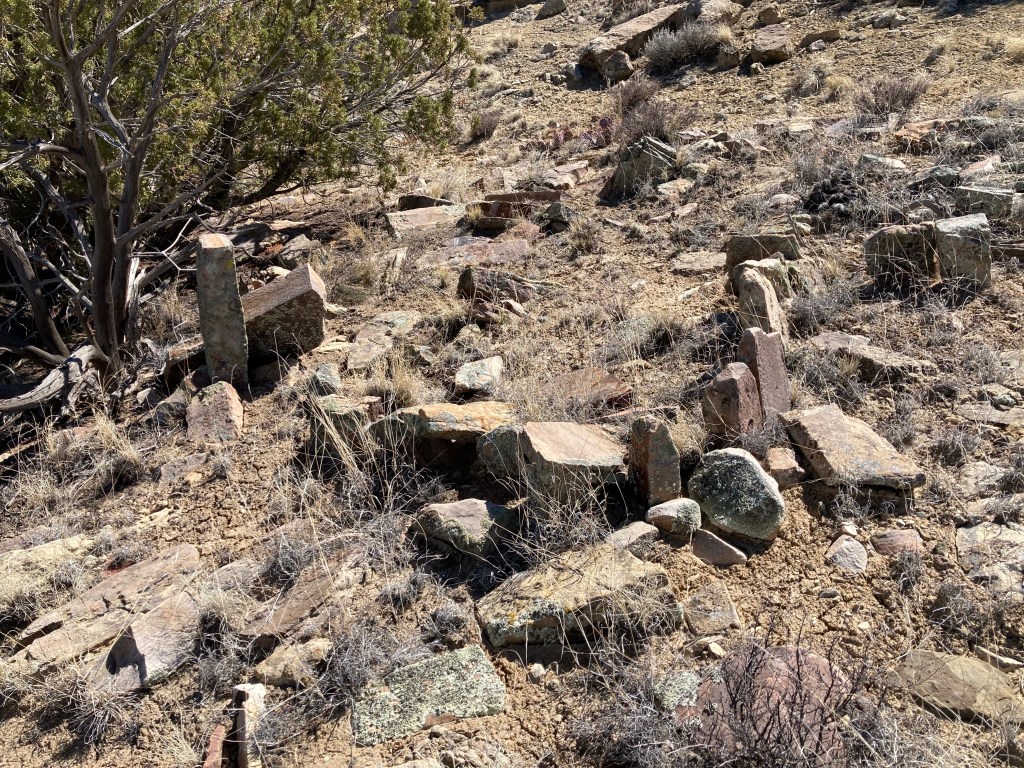
The square-cornered foundation and a couple of scattered sherds say Ancestral Pueblo, but both the vertical orientation and the size of the stones are unusual and impressive. Walls and roof–jacal style, the Southwest version of wattle-and-daub–have long since dissolved into the desert clay.
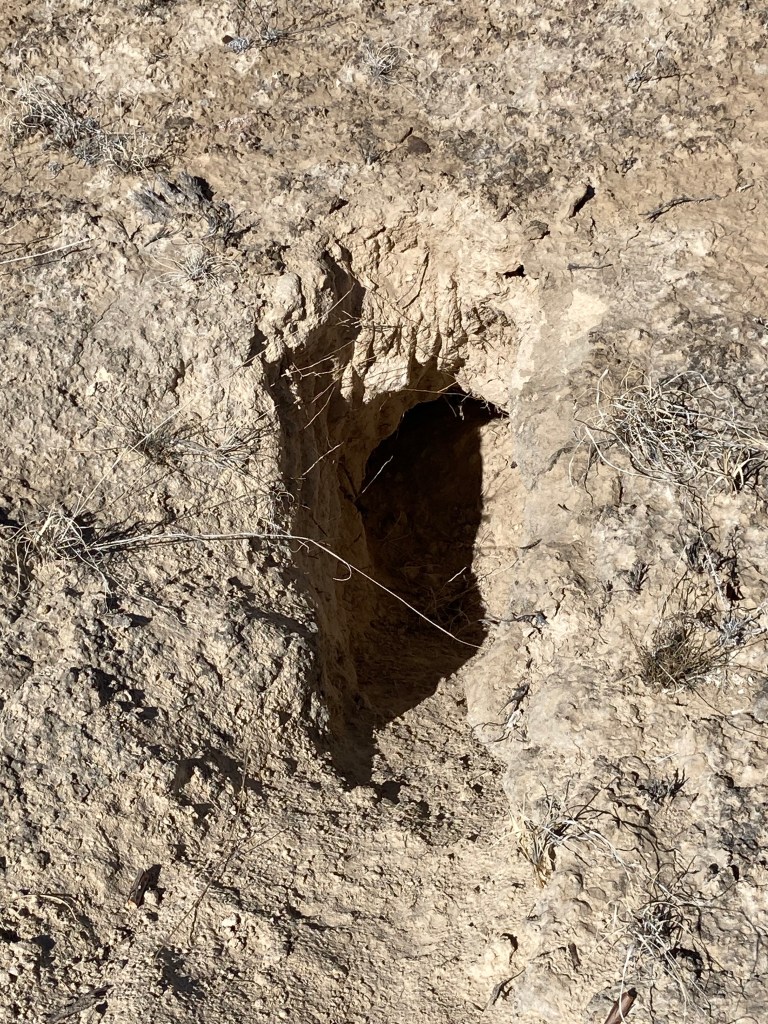
And another house. I have no idea whose, but the excavator left their claw marks above the doorway.
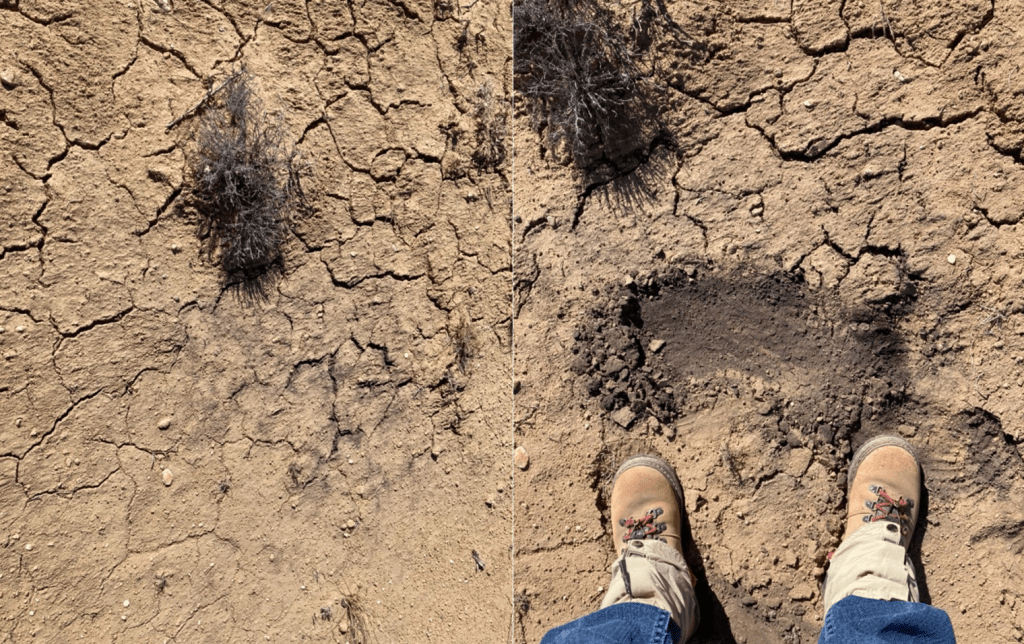
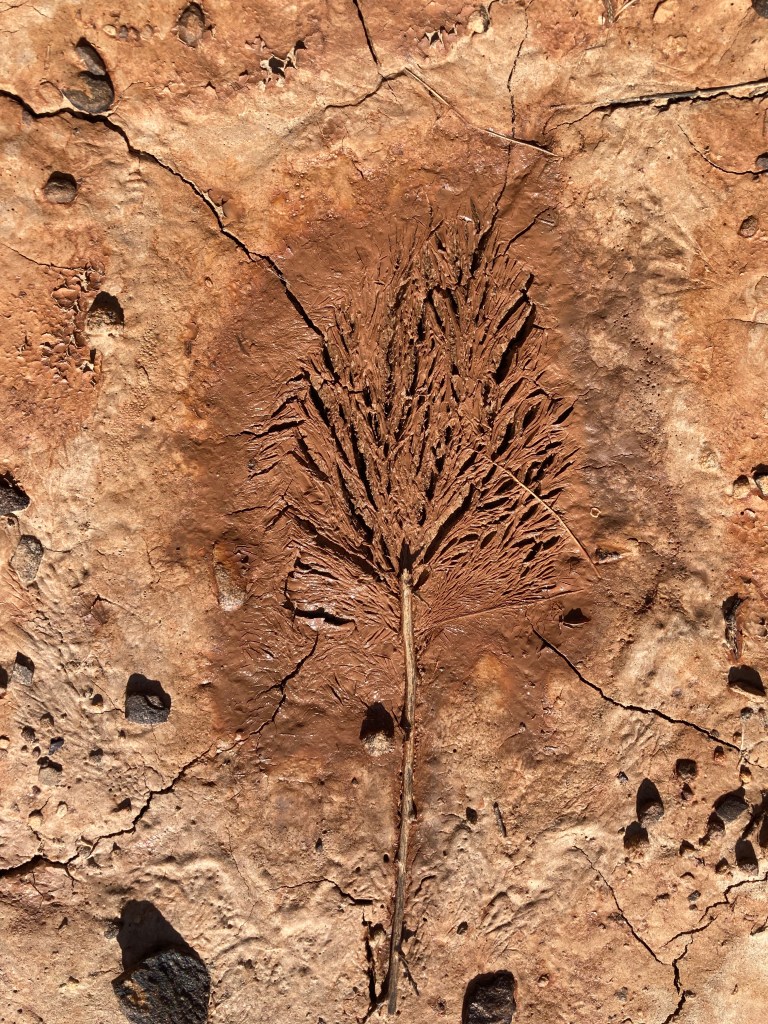
I vote for a jumping rodent. See how the footprints are clustered? Maybe a kangaroo rat? The soil is clay. It was sloppy mud a couple of weeks ago, now hard as ceramic. This dance should last until the next good rain.
We threaded the wind- and rain-scoured mesa rims among scattered flakes and potsherds of millennia. Here and there, a firepit so old that its ashes were only a faint stain in the dun soil.
The next wind and rain will hide it again. But the metate was in plain sight, the only flat surface among boulders. The last pecking to renew its grinding surface had become dark spots, and the worn surface on the left side was a smooth bowl under the hand.
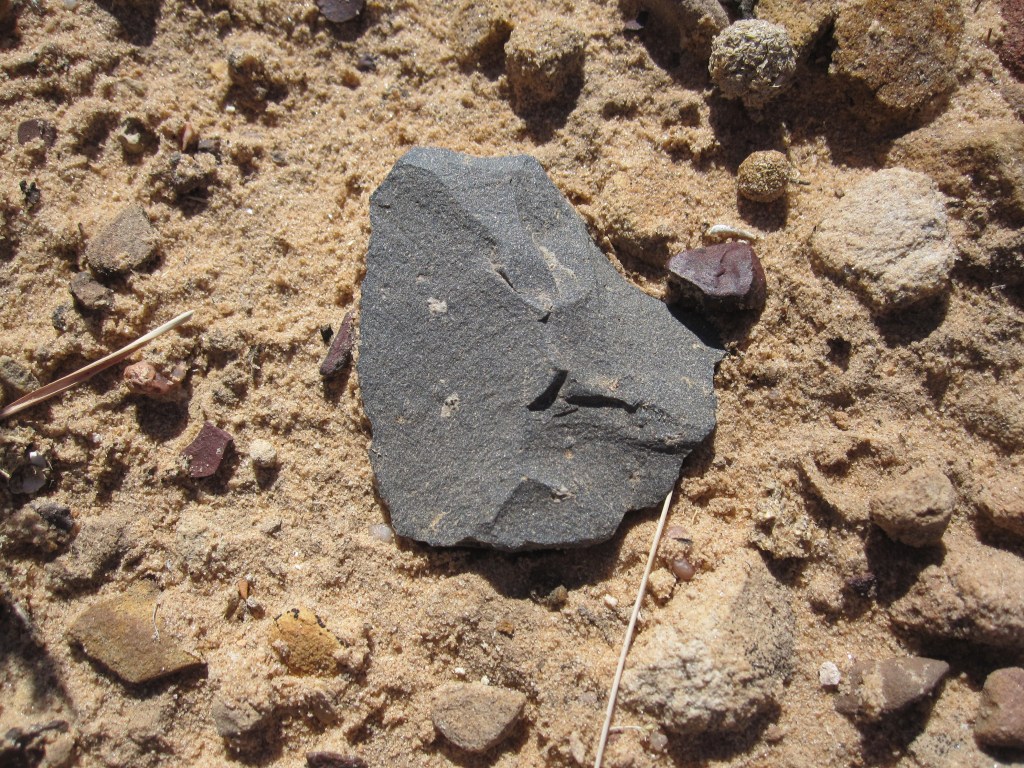
About seven thousand years ago, a culture that the invaders of five hundred years ago called the Bajada were making tools out of basalt.
Basalt. Were they crazy? Gluttons for punishment? Basalt is hard, grainy, homely, and close to impossible to knap. But by god it’s tough. It takes a lot to break it. Maybe that was the attraction?
We have to assume that the so-called Bajada–we have no idea what they called themselves, though they were all over the Southwest–were tough. And that hunters found a reason for their choice of that difficult material.
Where you find those basalt flakes you may also find the metate where gatherers ground wild grain:
Their camp is eroding into the arroyo. But if you’re alert you can spot what’s left of the place where folks sat around knapping basalt, sharing chapatis made of wild grains, and telling stories about the next seven thousand years.
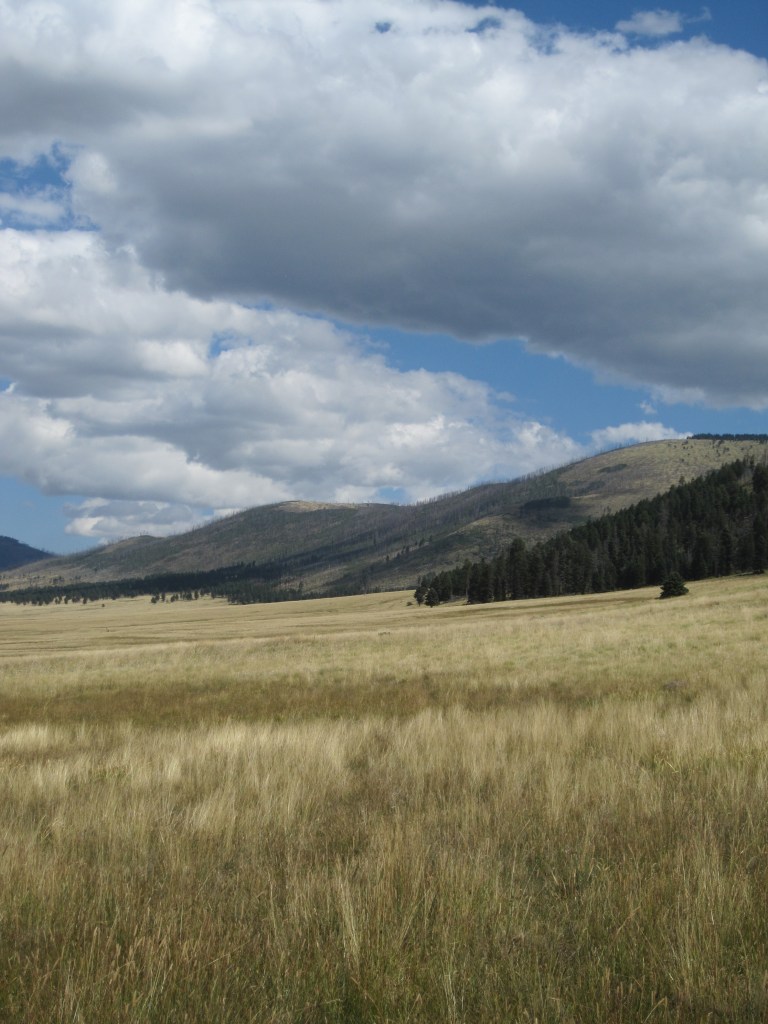
We set out from an altitude of about 9000′. Hiked down 800 vertical feet to the valley, where we picked up an elk trail fragrant with droppings. The grass was laid in the direction of travel, roughly northeast. We followed; the trail led us along the edge of the meadow, then abruptly back up the 800 vertical feet, through the ashy pine wood to the rim.
Never caught up to the elk. Probably they didn’t have to stop so often and sit down.
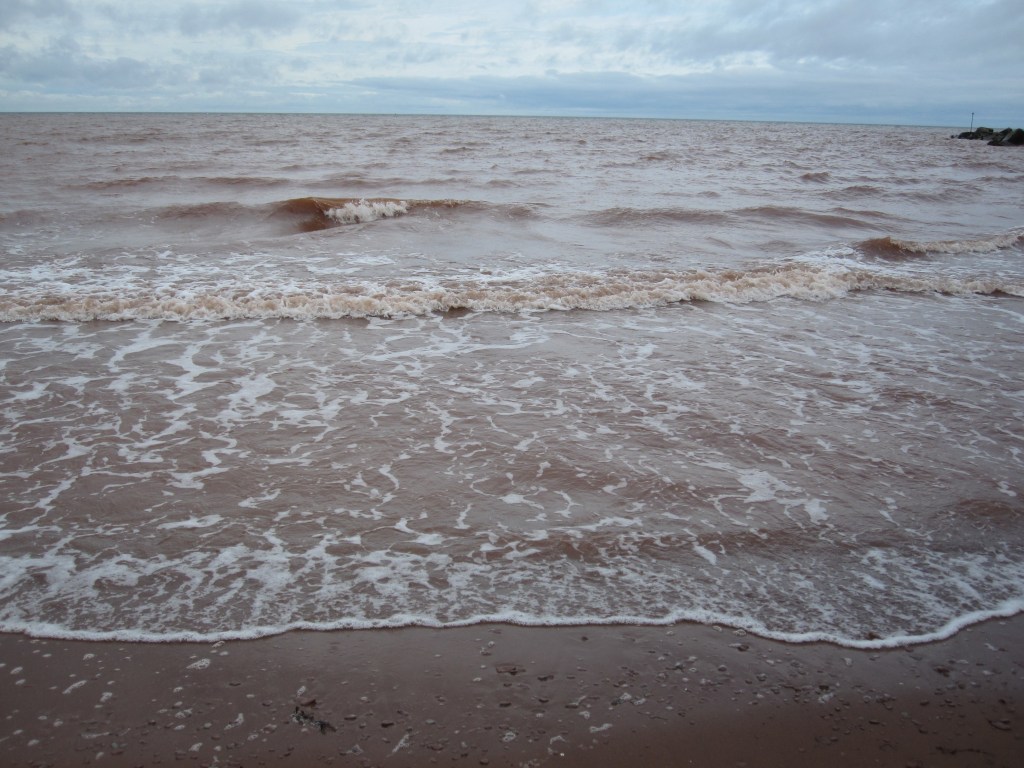
…but in the Triassic or thereabouts, when shallow seas and river deltas inundated where now we walk in the desert, it might have been. These are the red waves of the Bay of Fundy.
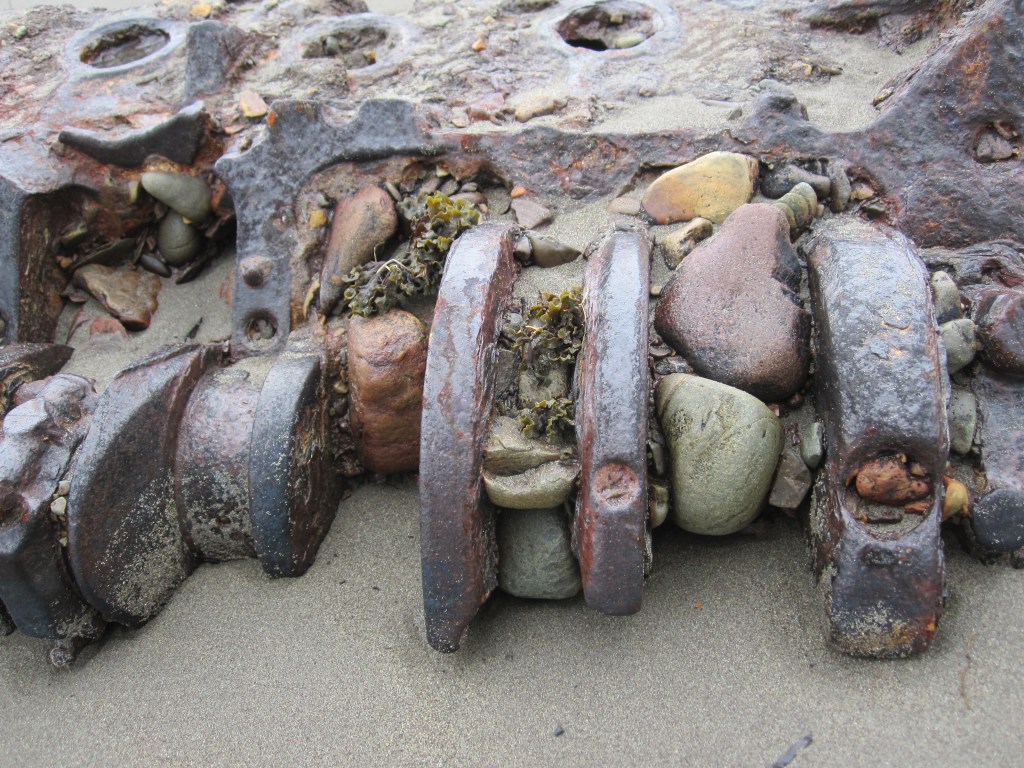
And this is how the waters of time soften and embellish the work of our hands:
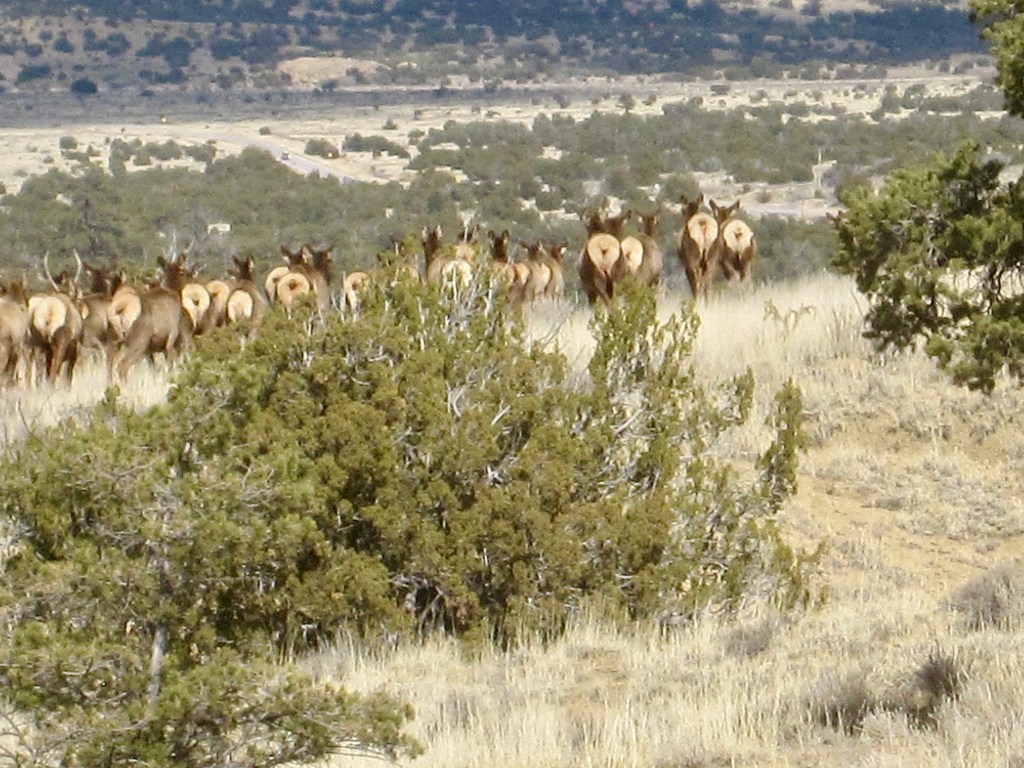
More than fifty elk, cautious but unworried, moved slowly away from us around the base of a narrow mesa. We hoofed it up the slope and across the mesa top in time to watch them leap two fences and head single file up the next ridge.
Not the best focus, but the best behinds.
Betsy James on Writing, Art, and Walking in the Desert




 WORLD-BUILDING and WILDERNESS: