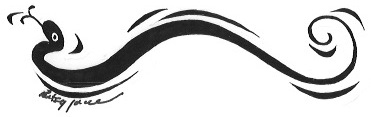
A snake dashed across the sandy road. A coachwhip, maybe? About three feet long and slender, a gorgeous dark coral. It left a trail of parentheses.
Our horned toads—the Desert Short-Horned Lizard—give live birth. Or rather, they incubate shell-less eggs in their bodies, and give birth to a litter of six to thirty-one (thirty-one!) infants still in their amnions, little marbles that break open into horned toads ready to run.
On Sandia Crest I came upon what must have been a recent birth, a fat adult with a salmon-colored chin and a handful of babies the size of bumblebees.
*
I’d never seen live water on Red Mesa before. High up it was milky, coming off the pale-yellow-to-gray sands and clays; below it was a rich red, thick with mud. We couldn’t get any wetter, so we waded right through the freshets that were neither sun-hot nor rain-cold but somewhere in between.
On the highway home, just east of the Ojito road, an arroyo roared down like ocean waves. Astonishing.
*
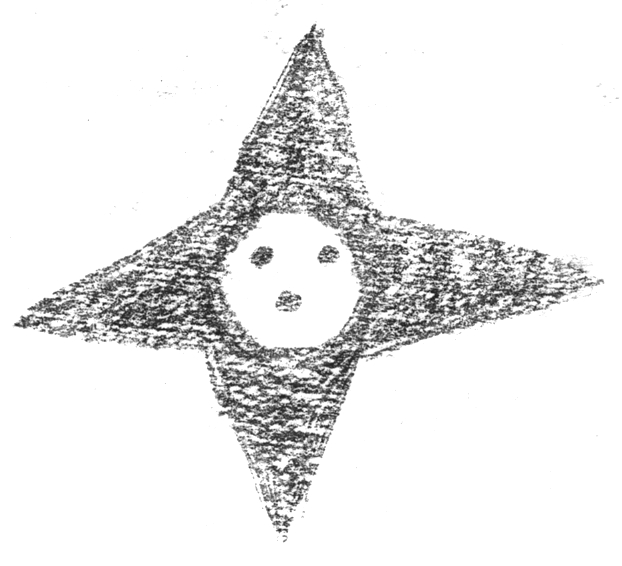
We went up the stony wash that is westernmost of the Syncline drainages, beautiful from the cliffs above. Petroglyphs on its water-scrubbed sides: a symmetrical spiral in dark desert varnish, and a pale Star Person almost erased by flashfloods. There was still a skim of water running down the linked pools.
*
*
In the Guadalupe Box area of the Jemez Mountains, on a boulder fallen from the sheer rhyolite cliffs, the five-foot-tall petroglyph of an eagle dancer.
Compared to the most ancient spirals and suns the work looks recent, but “recent” is relative: These mesas were refuges for the Pueblos when, ten years after their successful 1680 revolt, the conquistadores marched north from El Paso to retake New Spain.
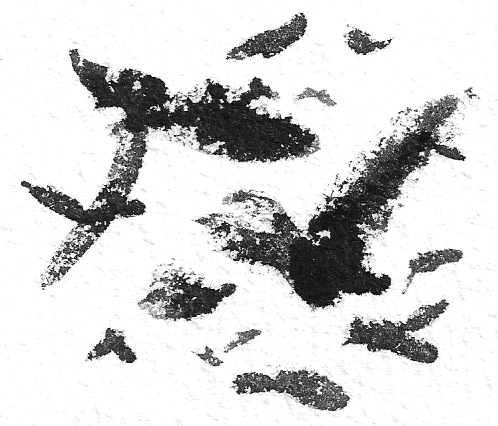
Smudged drawing from my pocket notes. Those feet: one human, one an eagle’s.
*