In the middle of the desert wilderness we came upon a wooden bed frame and a rusty hibachi, standing all alone in a meadow. Someone had built the bed a plywood bottom.
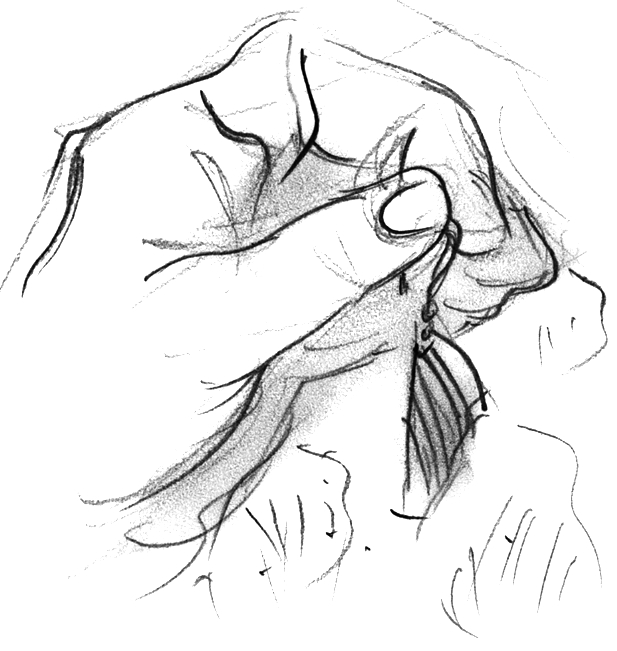
Snakeweed had grown up green all around. I picked a broken shell earring out of the sand.
Our horned toads—the Desert Short-Horned Lizard—give live birth. Or rather, they incubate shell-less eggs in their bodies, and give birth to a litter of six to thirty-one (thirty-one!) infants still in their amnions, little marbles that break open into horned toads ready to run.
On Sandia Crest I came upon what must have been a recent birth, a fat adult with a salmon-colored chin and a handful of babies the size of bumblebees.
I’d never seen live water on Red Mesa before. High up it was milky, coming off the pale-yellow-to-gray sands and clays; below it was a rich red, thick with mud. We couldn’t get any wetter, so we waded right through the freshets that were neither sun-hot nor rain-cold but somewhere in between.
On the highway home, just east of the Ojito road, an arroyo roared down like ocean waves. Astonishing.
White Mesa, Ojito: a crest of grass against the blue sky, round piñon trees along a stratified rose-and-white horizon. Light wind, pale skull of a moon.
Juniper berries are ripe. They taste like sweet turpentine. All the coyote scat is full of seeds.
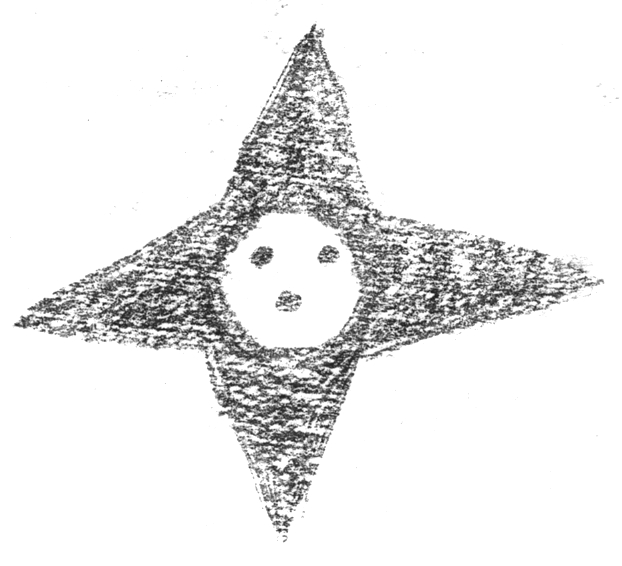
We went up the stony wash that is westernmost of the Syncline drainages, beautiful from the cliffs above. Petroglyphs on its water-scrubbed sides: a symmetrical spiral in dark desert varnish, and a pale Star Person almost erased by flashfloods. There was still a skim of water running down the linked pools.
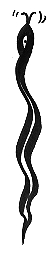
Foothills of the Nacimientos: a Western Diamondback was stretched in the morning sun. It coiled and cocked only when I shouted for the other hikers. Snakes are deaf, so it must have felt the vibration of my shout.
Posed, rigid, it never moved. John the fiddler said, “It’s a musical clef.”
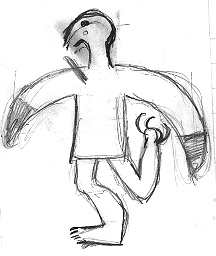
In the Guadalupe Box area of the Jemez Mountains, on a boulder fallen from the sheer rhyolite cliffs, the five-foot-tall petroglyph of an eagle dancer.
Compared to the most ancient spirals and suns the work looks recent, but “recent” is relative: These mesas were refuges for the Pueblos when, ten years after their successful 1680 revolt, the conquistadores marched north from El Paso to retake New Spain.
Smudged drawing from my pocket notes. Those feet: one human, one an eagle’s.
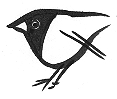
There are still a few Dark-eyed juncos in their little executioners’ hoods. When I make the birders’ “pishing” noise they get curious and come to about fifteen feet away, making a sound like agate pebbles tapped together.
Writer-illustrator Betsy James, in conversation with older readers.
I watched a charcoal garter snake with two brown stripes navigate the puddles of a rain-soaked road. Sometimes it crawled, sometimes it swam, fluid either way. I understood why Puebloan water deities—Kolowisi, Avanyu—are serpents.
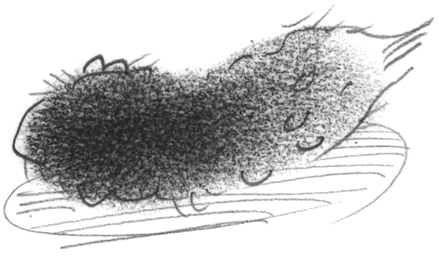
It lay still while I stroked it with a grass stem, then slipped away.
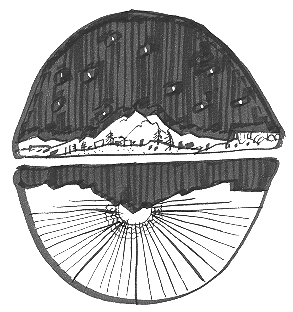
Standing in the middle of a dry field, the last blue-purple light in the sky, I thought: The world is round. The horizon is a circle, with the sky bowl over it like my grandmother’s domed paperweight of clear glass.
Wherever you stand is precisely the center of the world.

 In the middle of the desert wilderness we came upon a wooden bed frame and a rusty hibachi, standing all alone in a meadow. Someone had built the bed a plywood bottom.


 BETSY JAMES: Worldbuilding and Wilderness