All posts by Betsy James

Strange Place, Our Home Planet

Wasp nestOn the red dirt was what looked like a tatón, the fluffy white seed-puff of the river cottonwood…but it was strolling. I had to lie on my belly to see it was a spider. A spider! I have no clue.

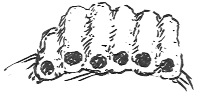
A mud-dauber’s nest with holes in a row, like a harmonica.

*

Grrrr!

Bear BonkerI spotted a rock that shouldn’t have been there: in a field of crumbled pink granite, a smooth gray stone. I pried it up. It was the butt of a buried stone axe, roughly whacked from a river cobble.

Once these mountains were full of grizzlies. Given its nasty point, was the axe a bear bonker? Should we hope not, for all concerned?

*

Here, Kitty, Kitty

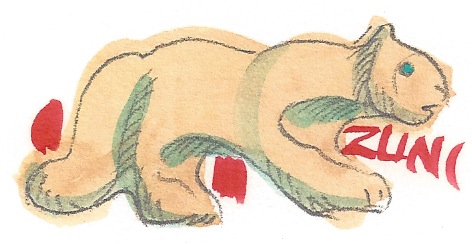
Mountain Lion FetishWhere we hiked Jan had found many mountain lion tracks. I learned that lions focus on small animals: I’m 4’11”. Small animals with high voices, actually. I dropped my usual backcountry shout by a good octave.

In Zuni the lion’s name is hokdidasha. Hokdidasha is—I think, but what do I know?—the beast priest of the north. The fetish shown is unsigned.

Resident Alien

Jerusalem CricketWe found a two-inch Jerusalem cricket—also called “child of the earth” or “earth baby”trudging stolidly at the arroyo-side.

Friend: Oh god, I think it looks like a little alien. Like an extraterrestrial fetus.

Me: I think it looks like a kid in a stripy T-shirt.

Friend: How benign. You’re perverse, but benign.

*

In Time We Fit

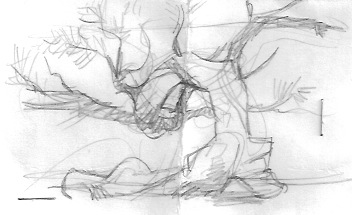
Old Juniper 5.17.09As we scrambled the scree slope to the mesa top, a lovely thing. The limb of an ancient juniper, vibrating in the cliff-edge wind, had worn a deep groove in the sandstone it leaned on, and had rubbed itself down to bare wood.

The fit was perfect even to the wood grain. A protruding knot on the limb had made a perfectly matching, knot-shaped hollow in the stone.

I was reminded of a word from…is it San Felipe Pueblo? Suyu: the sound of the wind as it hits the edge of the mesa.

*

Cliff-hanger

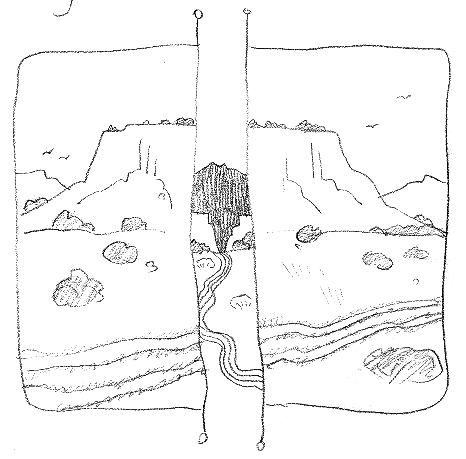
crumbling cliffOn an impossibly narrow peninsula of stone was a hunter’s paradise: it overlooked a game trail that crossed from one watershed to another. A hunter had only to wait.

And hunters had waited. On the peninsula was a thousand-year-old Archaic camp, its earth black with twelve to eighteen inches of ashy midden. Eighty feet above the valley floor, craning our necks, we could see that its crumbling north edge was formed of friable Tertiary sediments. The site itself looked “broken in half” like Dun Aengus, the cliff’s-edge fort from the Irish Iron Age, which the Atlantic has half devoured.

Following the game trail, we circled down to the bottom of the cliff. At its base stood an intact chunk of the site. It had slid from the edge where we had leaned and still stood upright, complete with ashes and flakes. On the cliff face rivulets of ashy mud trailed from the broken edge .

Ignorant, we had stood on that undercut, sleazy, brittle cliff’s edge, eighty feet above the valley floor.

Stinky Rattler?

VerticalSnakeDB143Best discovery: the source of that organic-metallic, pungent odor we call “snake smell.”

It has an oiliness, and always seems to occur near strata of barely-altered Cretaceous swamp not compressed enough to be coal. Yet I’ve heard many a desert rat say, “That’s rattler smell.” It has always made me aware of my ankles.

But it’s a plant. Thick, small, dark green leaves in pairs on a red stem. I couldn’t find it in Weeds of the West, but it looks like a vetch.

*