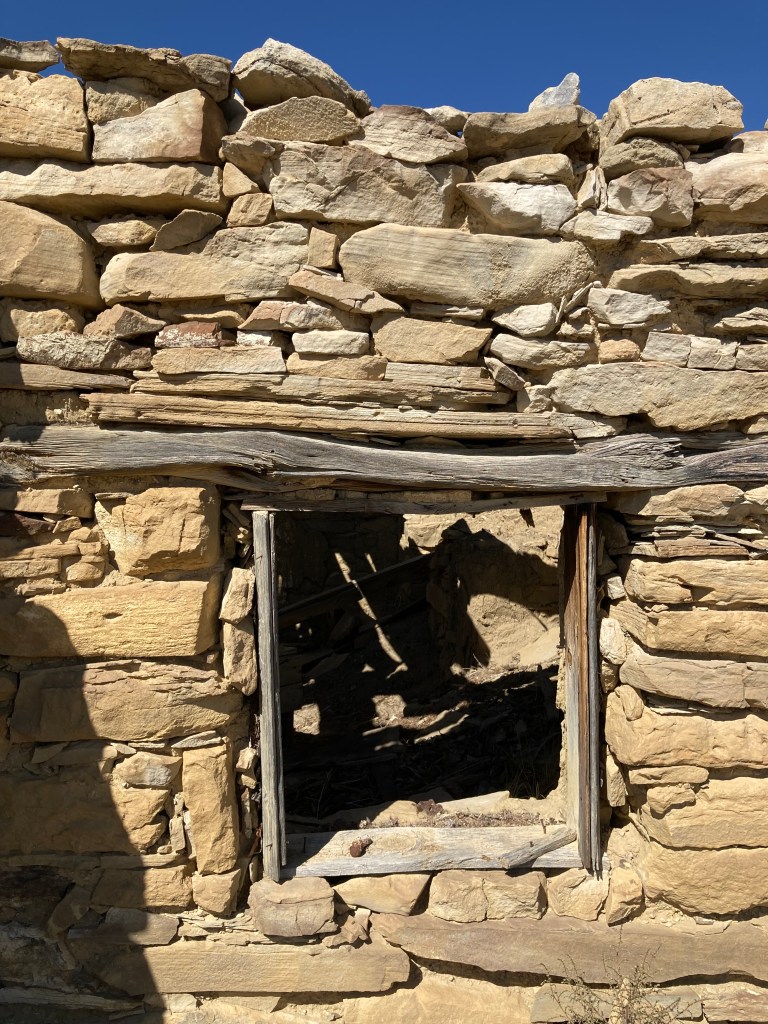
A nineteenth-century Hispanic homestead, long abandoned in its broadcast midden of rusty metal and purple glass. Axe-cut and adze-hewn beams, windows and doors trimmed with dimension lumber.
It was the first day cool enough, morning only, to scramble and side-hill in the mesa’s shadow. By noon the pale Cretaceous clay was too hot for pleasure.
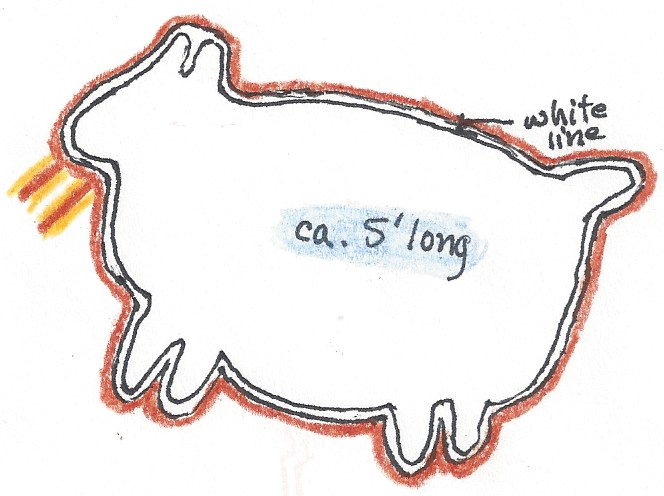
Under the overhang of a rock shelter was a pictograph that reminded me of a marrano, the pudgy gingerbread pig you can buy in every good Mexican bakery. For the (pigless and gingerless) pre-Columbian artist this may have represented a mountain sheep. It had been drawn in white, presumably gypsum, and outlined in red ochre. Each “slash” at the head was framed with yellow ochre.
I roamed off to snoop around a promontory over the creek, a flat expanse of red sandstone. Though there was a fallen, turn-of-the-century Hispanic ruin just west of it, the place felt untouched since earth’s morning. So quiet, so scoured by water and time—only flowers and the bending grass.
Betsy James on Writing, Art, and Walking in the Desert

 WORLD-BUILDING and WILDERNESS: