
 In a little clearing lay the perfectly articulated skeleton of a coyote, probably winter-killed. The skull with its gleaming teeth had been picked white and clean, but a bit of hide and sand-colored fur still clung to the delicate bones of one paw.
Tag Archives: hiking in New Mexico
Caught Knapping
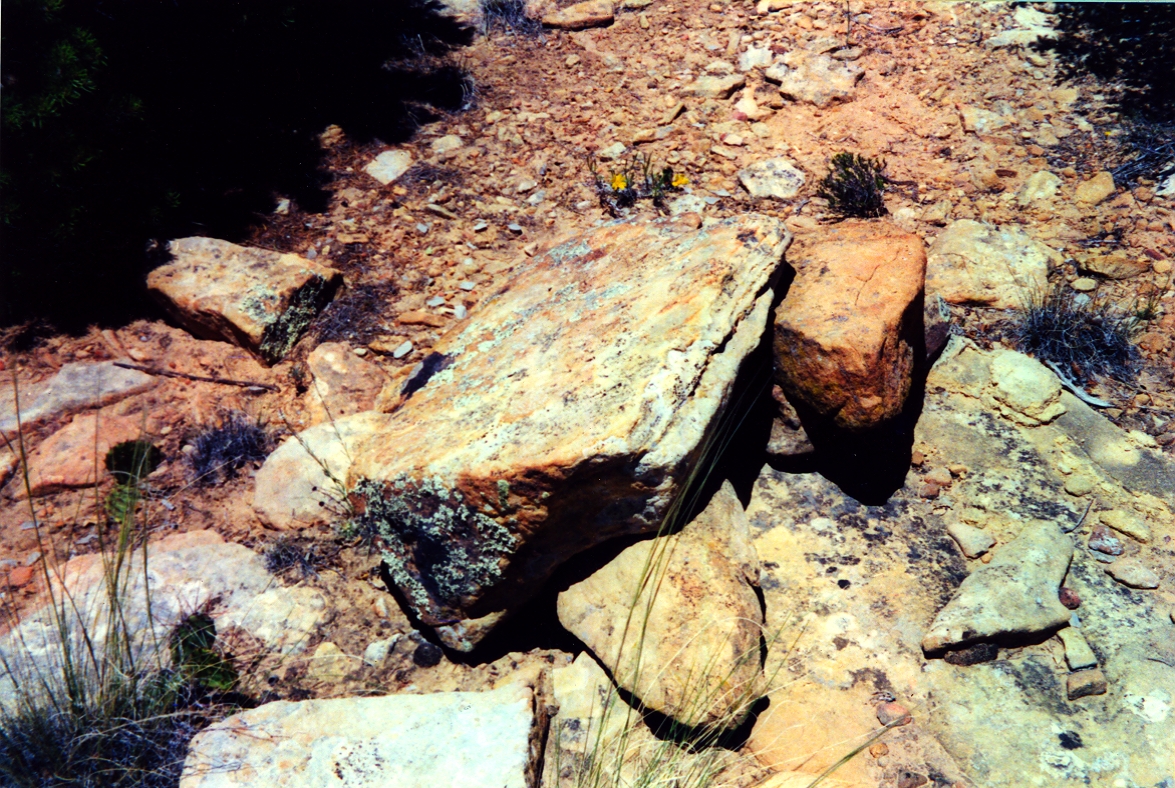 A flint knapper’s site. Flakes everywhere, all from the same crystalline quartzite core. The knapper had built himself a seat by propping a sandstone slab against two smaller rocks. Bill said he must have been an old guy with arthritis who had to get his chair just right.
To me the site seemed recent, say 300-500 years old: the slab had not toppled, the flakes had traveled only about thirty feet down the slope. But the quartzite was typically Archaic, which would put it back a thousand years at least. Possibly much more.
Hidden Honey
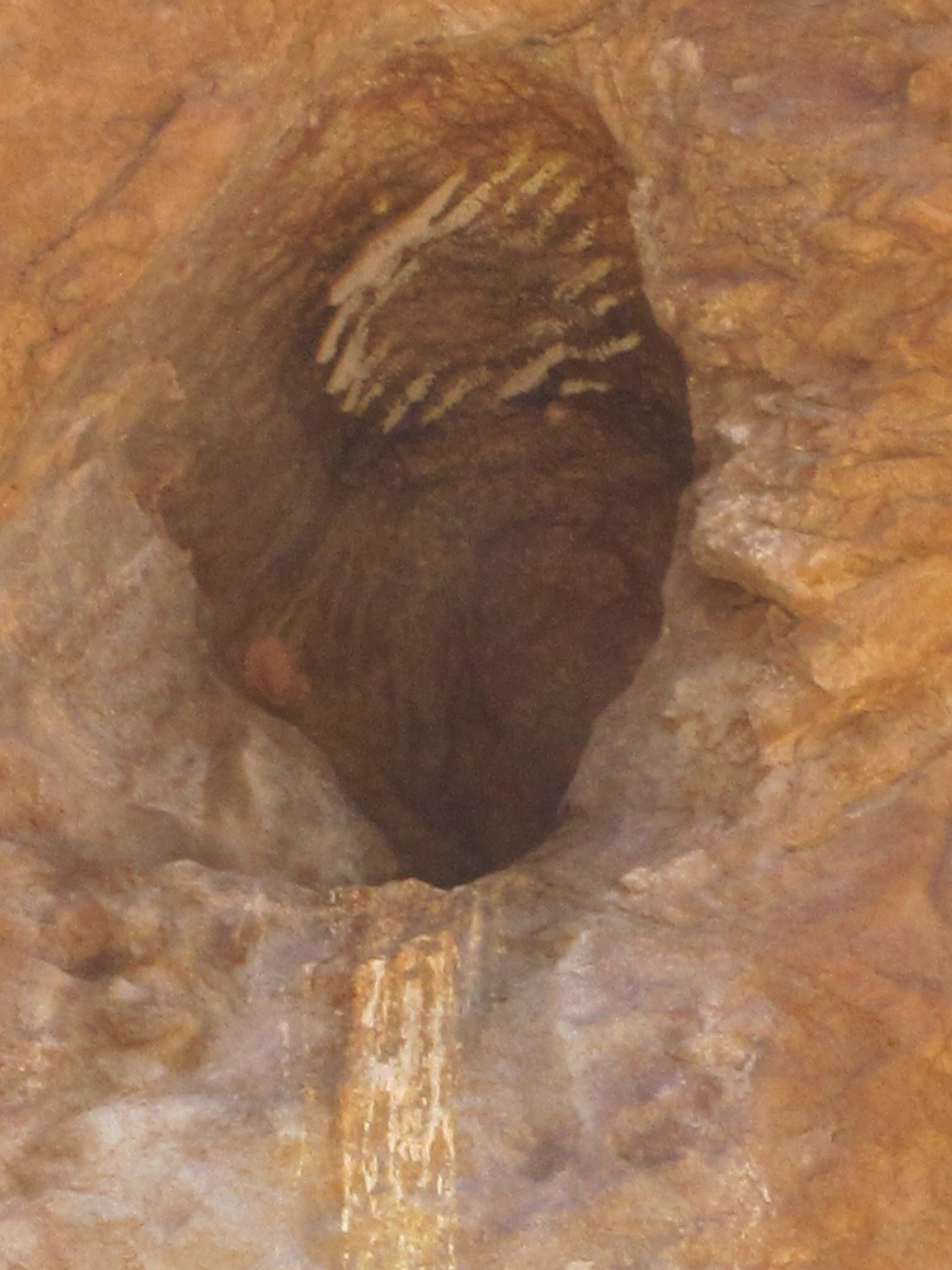 The dry stream bed we followed left the sandstone and entered a twisted granite canyon, narrow and deep-shaded. A barn owl startled and flew, soft clop of wings. High on the canyonside was its nest hole, the entryway streaked with mutes. Striations on the roof of it were the weathered wattles of a wild beehive, the remaining honey cells like waxy lace.
That hive was abandoned. But when we dug at a damp place in the sand, water welled up and thirsty bees came clustering. Somewhere in that canyon there is a hidden hive.
Visions
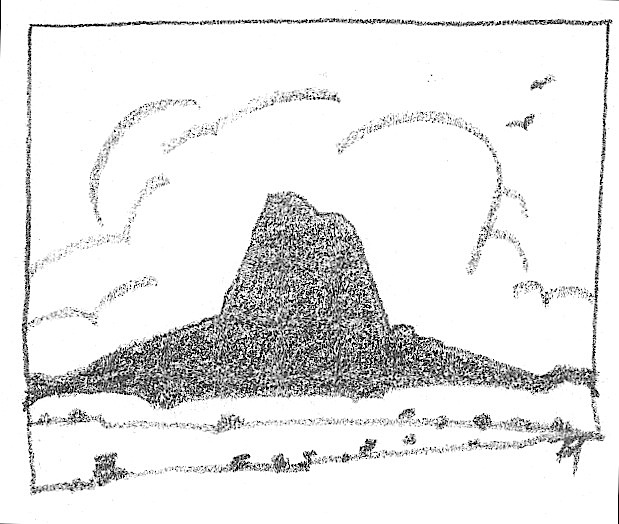 From the western ridge of the syncline a pass looks out over Cabezón, shadowy and shadow-washed. Many ancient, rudimentary stone circles scatter their boulders on high points. Each may be the site of a vision quest; we can think of no other explanation. Below lie mineral springs. One is raised on its deposits, a breast whose nipple is a pool, perfectly round, green as an old penny.
As we walked back along the ridge, some small creature far down among the split rocks screamed at us: Squee! Squee! Squee! An ear-splitting insult that never stopped until we went away.
In Just Spring
 A tiny harlequein horned toad with reddish body, gray legs and stripy gray tail. Was it so variegated because it lived among multicolored gravels? It was barely the size of a quarter.
Later in the day we came upon truly horny horned toads, a mating pair. The female was fat and tan, the male slender and ash-colored. When we came close to look they fled, but they fled together. The male, even in fear, followed the female and would not lose her.
Unforced
 Penistaja Mesa, tohellandgone west of Cuba. Cabezón dim and blue on the horizon. Tertiary strata, sometimes black with almost-coal. Everywhere petrified wood: enormous whole logs weathering into chips, as though we walked through slash left by a mad stone woodcutter.
Penistaja is probably a corruption of the Navajo binishdaahi’, “I forced him to sit.” So we sat.
Wilderness First Aid
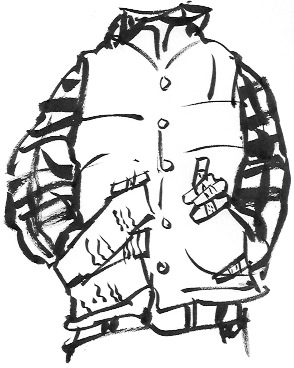 To the Ojito Wilderness with a friend and his big German shepherd, Chaco. Not thirty yards from the car, Chaco joyfully jumped me. I tried to yank my hands out of the pockets of my $2.50 Goodwill vest to fend him off. It tore, and clouds of duckie down floated away on the wind.
We patched the rips with radiator hose repair tape and Band-aids.
Hard Times
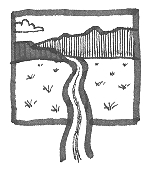 Arroyo de la Caña. A small, gray-tan bobcat caught by its hind leg in a “legal” trap. Not much bigger than a house cat. It growled at us in a singsong. We came as close as we dared. One of us—not wise to the strength and wildness of bobcats—wanted to throw a coat over it and try to release it, in spite of its broken leg.
As we hiked away a fierce-faced, bearded man drove up in a big pickup. Bobcat skulls, and probably skins, bring a price. I’m not sure how much, but New Mexico is very poor.
Holy Water
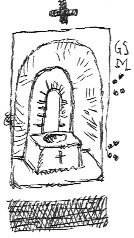 In the Cebolla Wilderness, an abandoned ranchito with tin shack and corrals. North of it was a steep, stone arroyo with a spring at its head. Filling the gap between two huge stones, a springhouse had been built around the frozen pool. Inside, back in the dark and the smell of water, a tiny shrine was cut in the living rock.
The chisel marks were clear. The santo that had stood there was gone, as was the grille that had protected it, though the scars of the grille’s hinges remained. The empty nicho was touched with blue paint. Carved in front of it was a shallow bowl—for a votive candle, or for water from the spring? There was a stone to kneel on.
The dim interior, the narrow rock passage and frozen pool, the tiny shrine: it felt like a megalithic tomb, something much older than itself.
*
Rock and a Hard Place
 Bushwhacking near the Continental Divide Trail. Broken land: stone, mud, sand, concretions. Overall colors are dun, but sometimes, bright against the yellow, a deep red or black. Weathered, skeletal, not a land friendly to humans. No water but the distant Puerco River. Sagebrush and juniper—the piñon is dead from drought.
The particular crisp softness of walking on frost-heaved Cretaceous dirt.
A doe and her grown fawn floated away from us, bouncing light as…but nothing bounces light as a deer.
*
 WORLD-BUILDING and WILDERNESS: