*
 On a canyonside in the Zuni Mountains we hiked to a little cave, a rock shelter that had been sadly pot-hunted. In it, among the ashy dust, the soot-blackened potsherds and tiny, prehistoric corncobs, was the paw-print of a mountain lion.
*
*

*
On a canyonside in the Zuni Mountains we hiked to a little cave, a rock shelter that had been sadly pot-hunted. In it, among the ashy dust, the soot-blackened potsherds and tiny, prehistoric corncobs, was the paw-print of a mountain lion.
*
*
Writer-illustrator Betsy James, in conversation with older readers.
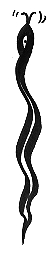 I watched a charcoal garter snake with two brown stripes navigate the puddles of a rain-soaked road. Sometimes it crawled, sometimes it swam, fluid either way. I understood why Puebloan water deities—Kolowisi, Avanyu—are serpents.
It lay still while I stroked it with a grass stem, then slipped away.
*
•
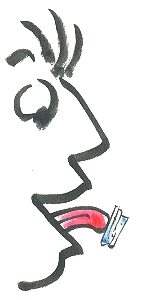 In the Cretaceous mud we found a shattered dinosaur thigh by following fragments of petrified bone scattered down an arroyo.
But—I think I’ve explained this before—if you find a tiny piece, how can you tell whether it’s a dissolving dinosaur?
Lick it. If it’s bone, rather than some other stone like agate or silicified wood, the porous vesicles left by once-living cells and capillaries will wick up the moisture of your tongue, and it will stick.
Writer-illustrator Betsy James, in conversation with older readers
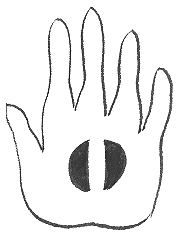 In the sand of the Ojito Wilderness, a cracked Archaic mano, a grindstone. Crystalline quartzite, red and white and yellow, with a slanted edge that provided a perfect grip. I hooked my fingers there, seeing another woman’s hand: small like mine, probably young, with broken nails.
After twenty centuries, the stone remembers that other hand.
*
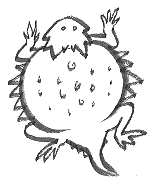 From a faded pamphlet on Navajo folklore I learned that a horned toad can make an arrowhead by choosing a stone and running around it. This is why you’ll sometimes find an arrowhead where there was none before.
*
*
 Red Mesa. Up the roughest canyon to the plunge-pool cave, the scoured sandstone channels. We put our backs against the stone and listened to the Ponderosa sigh. In the midst of this communion I found a thermos of hot chocolate had come open in my pack.
Along the arroyo I picked up a clump of breast feathers, each pointed with a tiny dark heart.
*
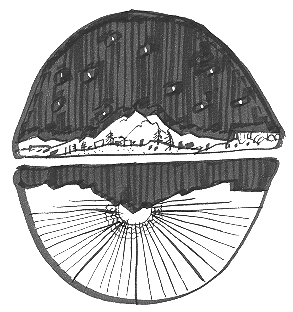 Standing in the middle of a dry field, the last blue-purple light in the sky, I thought: The world is round. The horizon is a circle, with the sky bowl over it like my grandmother’s domed paperweight of clear glass.
Wherever you stand is precisely the center of the world.
*
*
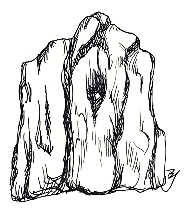 Hiking the Piedra Lumbre area of La Leña. A cold, dry day with a storm moving in.
Lots of petrified wood. Not the brilliant agates we see so often but a frail, glittering mudstone that preserves knotholes and wormholes, almost the worm itself.
Fossil tree trunks dissolve into perfect wood chips: the desert floor is littered as though a stone woodcutter had passed, chopping stone trees for a stone fire.
*
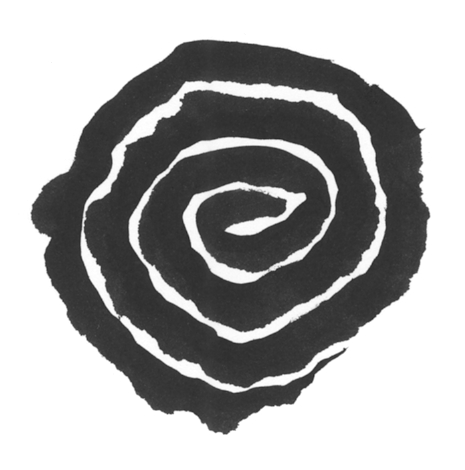 Hiking the red Triassic, we stopped to admire a wide, round, hissing spring that had been bubbling up CO2, methane, and hydrogen sulfide for a hundred thousand years.
In the Pleistocene this area must have boiled like Yellowstone, for all around were the empty vats of dry springs, thirty to sixty feet deep. If you fell in you could never get out—nor, so far off trail, would you be found. The living spring, presumably as deep, was capped with a peaty mat formed by the accumulated sedge roots of millenia, thick enough—we hoped—to support our weight.
We walked across. It trembled subtly under our feet, like an acqueous drum.
*
 Hiking in the volcanic world of the Jémez Mountains, whose pavement of shattered obsidian has been mined by flint-knappers for twelve thousand years. Among the glittering prehistoric shards, a recently discarded cigar.
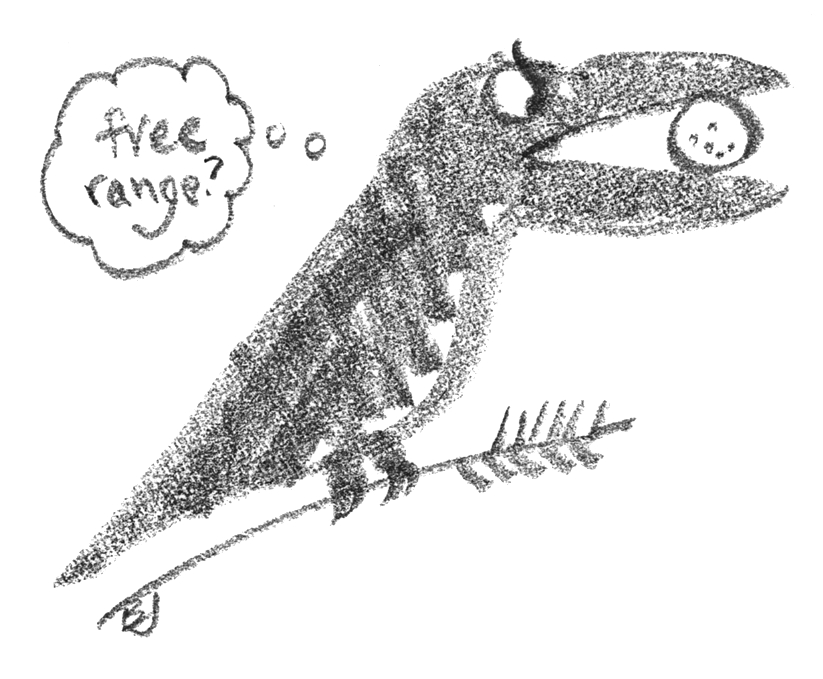
Cochití Golf Course nudges the Jémez wilderness. As we walked Jan told the story of finding, at the foot of a tall Ponderosa a mile from the course, about fifty white golf balls within a radius of thirty feet.
That’s one disillusioned raven.
*
 WORLD-BUILDING and WILDERNESS: