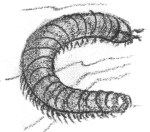
Jemez foothills in thunder season. A rattler was getting the heck out of there. A million millipedes the color of violins were footing it furiously, looking like baby snakes.
Jan said, “It’s the crawliest day I’ve seen in a long time.”*

Jemez foothills in thunder season. A rattler was getting the heck out of there. A million millipedes the color of violins were footing it furiously, looking like baby snakes.
Jan said, “It’s the crawliest day I’ve seen in a long time.”*
 Foothills of the Nacimientos: a Western Diamondback was stretched in the morning sun. It coiled and cocked only when I shouted for the other hikers. Snakes are deaf, so it must have felt the vibration of my shout.
Posed, rigid, it never moved. John the fiddler said, “It’s a musical clef.”
*
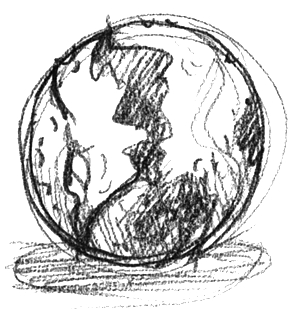 In the remote Pecos I found a big marble from the 30s: white-and-butterscotch glass, battered and frost-spalled, buried in dirt. It appeared to have been thrown off a mesa.
The inexplicable things one finds in the wilderness! I assume it had lain in the dirt for as many years as its age: seventy or eighty.
*
 Slow, huge thunderheads.
Rain had washed everything, as though it had doused the desert with a gigantic fire hose. The daisies’ faces were plastered to the ground.
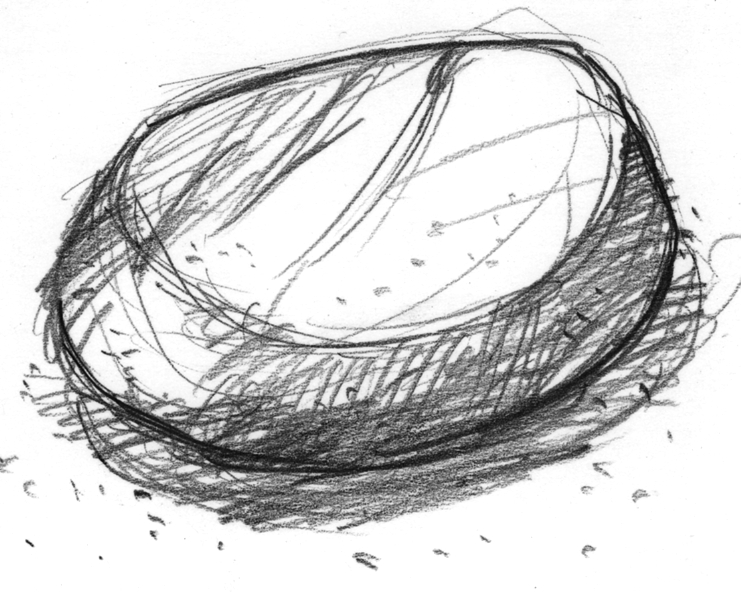
A pretty mano of pink granite. Where it lay was wilder than when it was made by an Archaic hunter-gatherer, probably a woman: only the rare hiker goes there now. The mano had been looking at the sky for two thousand years, at least. I admired it, then left it to its next eons of quiet and space and rain.
*
 In the Jemez Mountains we hiked among the Tent Rocks: eerie, beautiful. Pink-white ashy pumice forms teepees, minarets, cupolas, gables, totem poles, shrines—their bases scalloped like coconut-cream popsicles, their tops jagged as blades. Don’t slide off; by the time you got to the bottom you’d be, not just dead, but completely skinned by volcanic glass. As we crept along the steep sides of the hills each of us touched the slope with one hand.
The ash is full of obsidian, Apache Tears.
*
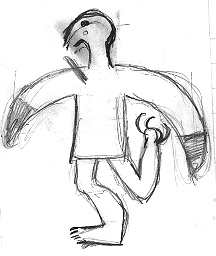 In the Guadalupe Box area of the Jemez Mountains, on a boulder fallen from the sheer rhyolite cliffs, the five-foot-tall petroglyph of an eagle dancer.
Compared to the most ancient spirals and suns the work looks recent, but “recent” is relative: These mesas were refuges for the Pueblos when, ten years after their successful 1680 revolt, the conquistadores marched north from El Paso to retake New Spain.
Smudged drawing from my pocket notes. Those feet: one human, one an eagle’s.
*
 Peralta Canyon, Jemez: pictographs in red ochre. Finger marks, in groups along ridges of rock next to the creek; one faint handprint; stars, turtles, and this pretty sun face.
Unlike those of the classic Zia symbol, all its rays are of equal length. The slanted ones may be feathers. It had been painted with a finger, and seemed to be subtly smiling.
*
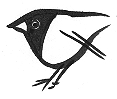 There are still a few Dark-eyed juncos in their little executioners’ hoods. When I make the birders’ “pishing” noise they get curious and come to about fifteen feet away, making a sound like agate pebbles tapped together.
Last year’s old apples smell like cider vinegar.
*
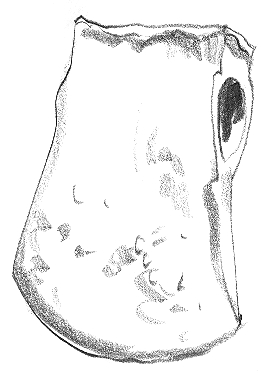 In the cobble hills above the Rio Puerco. Rain, snow, thunder. I was afraid of lightning, but Jan sheltered calmly under a juniper that bore the black scars of a previous strike. The wind smelled of wet stone.
In the sand lay an iron axehead, its handle long ago lost to weather. From the eighteen-eighties, maybe. The edge had a graceful worn curve, and the splayed butt showed it had been used as a wedge to split firewood.
*
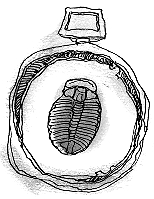 In the trackless mudstone of Piedra Lumbre, five or six hogan rings: stone foundations with east-facing doors, still holding what was left of the cribbed juniper rafters of traditional Navajo houses. Judging by the decay of the juniper, well over a hundred years old. Beyond them, two circles of ash filled with fragments of trash, probably fires that burned the deceased’s possessions. The squashed casing of a cheap nickel pocket watch.
*
 WORLD-BUILDING and WILDERNESS: