Bushwhacking in the dense piñon-juniper and oak brush that covered the mesa, on a windy day that obscured all sound. I was newly aware of how one tracks companions by constant, quick glances through the twiggage, near-subliminal glimpses every four to eight seconds: a scrap of color, a blink of movement out of place against the moving background. It’s an almost-unconscious art, and takes practice. First we lost Rob, then Gary, then John.
They all straggled in later at the car, remarking on how, in countryside like this, a group can get separated in less than a minute. Their shouts had been inaudible in the wind.
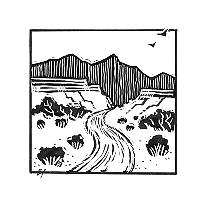
Hiking the canyon of the Rio Santa Fe, over our heads the stone-cribbed hairpin turns that carried Spanish wagons, Civil War soldiers and Model Ts up this section of the Camino Real. The eroding pale strata of the canyon walls were capped by tumbled, slightly columnar basalt.
At the cliffs’ feet the rio’s busy water looped and twinkled. It smelled chemical; it was runoff from Santa Fe’s sewage treatment plant, equal parts groundwater from Buckman Wells and bottled water from Fiji that had been filtered through wealthy Santa Feans. Winding down that river was, no doubt, a lot of cocaine.
In the sedge at the brink I nearly stepped on a bull snake. We left, abruptly, in opposite directions.
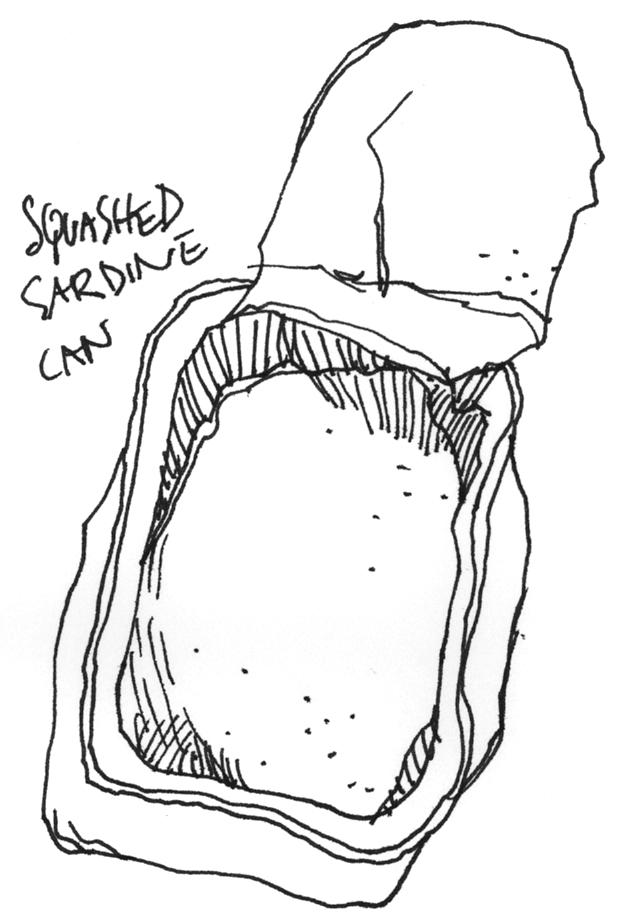
Besides its many miles, the best part of the hike was a lonely homestead perched on a rise in the sandstone. For the backcountry, where until the late 1860s Navajo raids made life unhealthy, this settlement was very early. Not even the shape of the house was left, just a heap of stones, but the trash—! Purple glass and thick white china reduced to confetti, buttons, shreds of wire, squashed Prince Albert tobacco cans and unrecognizable bits of rusty metal were scattered over acres.
It was support for my theory that early settlers, uneasy in the wilderness, liked to look at their civilized garbage.
White Mesa, Ojito: a crest of grass against the blue sky, round piñon trees along a stratified rose-and-white horizon. Light wind, pale skull of a moon.
Juniper berries are ripe. They taste like sweet turpentine. All the coyote scat is full of seeds.
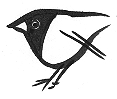
There are still a few Dark-eyed juncos in their little executioners’ hoods. When I make the birders’ “pishing” noise they get curious and come to about fifteen feet away, making a sound like agate pebbles tapped together.
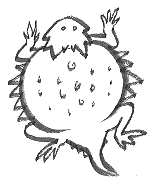
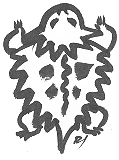
From a faded pamphlet on Navajo folklore I learned that a horned toad can make an arrowhead by choosing a stone and running around it. This is why you’ll sometimes find an arrowhead where there was none before.
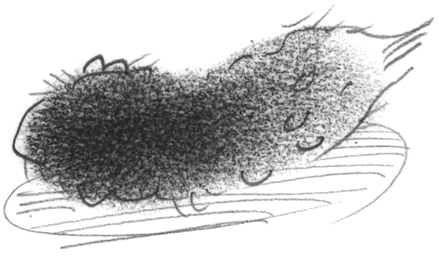
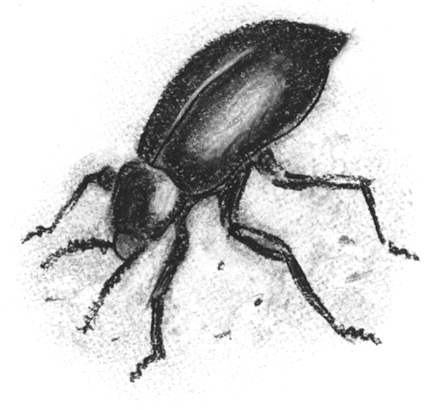
In Zuni, if I have it right (and often I don’t), you go through several incarnations after this human one. The first are as food-giving game animals like deer or antelope. But the last—right before you go to heaven to dance for eternity—is as sho:mi:do’kya, the little black stinkbug that raises its tail on our desert’s red earth.
I once had a stinkbugcrawl into my old Intellifax 1270 and die there. This caused a paper jam and permanent scratches on the drum, but I felt kind of touched that somebody went to heaven from my fax machine.
A day both cool and warm. Hazy clouds, pumice sand underfoot, soft wind hushing in the ponderosa. The water of Peralta Creek was icy with runoff, milky with pumice dust.
We bushwhacked up a box canyon full of oak brush and wild roses; I bled furiously. Strong smell of skunk or weasel. A swallowtail butterfly in erratic flight, bright yellow among the worn boulders.
Caught the first horned toad of the year: a fat one, with salmon belly and yellow side-fringe. About the size and heft of an Oreo cookie.
*
Betsy James on Writing, Art, and Walking in the Desert

 Bushwhacking in the dense piñon-juniper and oak brush that covered the mesa, on a windy day that obscured all sound. I was newly aware of how one tracks companions by constant, quick glances through the twiggage, near-subliminal glimpses every four to eight seconds: a scrap of color, a blink of movement out of place against the moving background. It’s an almost-unconscious art, and takes practice. First we lost Rob, then Gary, then John.
 WORLD-BUILDING and WILDERNESS: