The Syncline: The sandstone ponds had had a flashflood through them. In the lower pools the willows were torn and full of wreckage, but the higher ones were beautiful. We went in naked on the sandy, gravely mud.
Polliwogs and froglets nibbled us. We slid down the algae-coated water chutes of the linked pools; the stream’s steady drip from pool to pool became overflow as our bodies displaced water.
So quiet! Wind in the cottonwoods, sun on the washed stone, warm breeze on bare skin. Absolute peace.
My pencil fell out of my pack; I took these notes on a three-by-five card by scratching with a rock.
At the top of the acequia was a tunnel in the side of the mountain, originally a mine. I couldn’t see into it—it was dark and the day was bright. But away back in there I could make out a reddish door; the sound of water came from behind it. Across the square black tunnel mouth orb spiders had built three perfect webs, one after another.
In the middle of the desert wilderness we came upon a wooden bed frame and a rusty hibachi, standing all alone in a meadow. Someone had built the bed a plywood bottom.
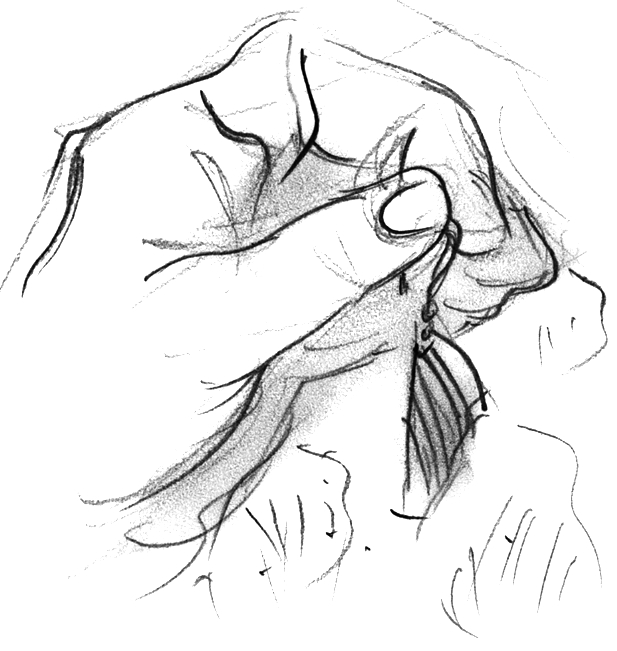
Snakeweed had grown up green all around. I picked a broken shell earring out of the sand.
Our horned toads—the Desert Short-Horned Lizard—give live birth. Or rather, they incubate shell-less eggs in their bodies, and give birth to a litter of six to thirty-one (thirty-one!) infants still in their amnions, little marbles that break open into horned toads ready to run.
On Sandia Crest I came upon what must have been a recent birth, a fat adult with a salmon-colored chin and a handful of babies the size of bumblebees.
Rain-soaked sandstone is unstable. Hiking upcanyon, we found a boulder the size of a Winnebago that had peeled off the mesa and bashed a fifteen-foot-wide swath down the scree slope.
It had taken out the piñones, hit the canyon bottom, run up the opposite side, rolled back down, bounced a couple of times and settled back to dam the creek into a fine little trout pool.
The bashed pine needles were still green, but the pool already had a half dozen six-inch fish in it.
I’d never seen live water on Red Mesa before. High up it was milky, coming off the pale-yellow-to-gray sands and clays; below it was a rich red, thick with mud. We couldn’t get any wetter, so we waded right through the freshets that were neither sun-hot nor rain-cold but somewhere in between.
On the highway home, just east of the Ojito road, an arroyo roared down like ocean waves. Astonishing.
White Mesa, Ojito: a crest of grass against the blue sky, round piñon trees along a stratified rose-and-white horizon. Light wind, pale skull of a moon.
Juniper berries are ripe. They taste like sweet turpentine. All the coyote scat is full of seeds.
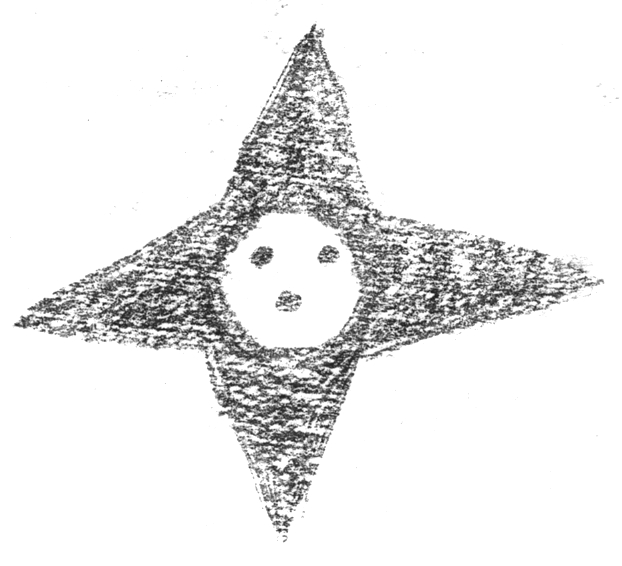
We went up the stony wash that is westernmost of the Syncline drainages, beautiful from the cliffs above. Petroglyphs on its water-scrubbed sides: a symmetrical spiral in dark desert varnish, and a pale Star Person almost erased by flashfloods. There was still a skim of water running down the linked pools.
Jemez foothills in thunder season. A rattler was getting the heck out of there. A million millipedes the color of violins were footing it furiously, looking like baby snakes.
Jan said, “It’s the crawliest day I’ve seen in a long time.”*
Foothills of the Nacimientos: a Western Diamondback was stretched in the morning sun. It coiled and cocked only when I shouted for the other hikers. Snakes are deaf, so it must have felt the vibration of my shout.
Posed, rigid, it never moved. John the fiddler said, “It’s a musical clef.”
*
Betsy James on Writing, Art, and Walking in the Desert

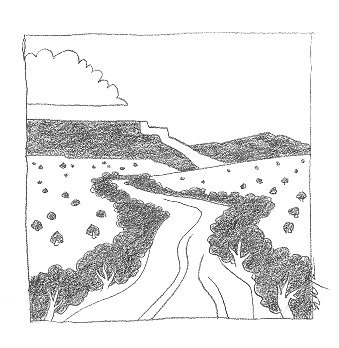 The Syncline: The sandstone ponds had had a flashflood through them. In the lower pools the willows were torn and full of wreckage, but the higher ones were beautiful. We went in naked on the sandy, gravely mud.



 WORLD-BUILDING and WILDERNESS: