All posts by Betsy James

Firewalking

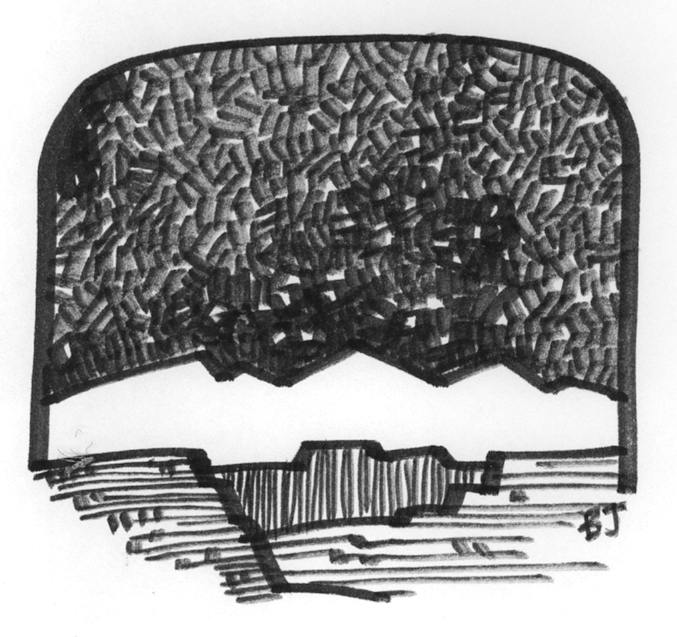
On the McCartys flow, the most recent in the Malpais. Easy walking, the lava ropy and wrinkled as a rucked-up rug, chink, chink of volcanic glass underfoot. I should have worn leather-palmed gloves; I was aware of my bare hands.

Navajo folklore has a story about the flow: the gods threw fire. Because the Navajo are recent arrivals from British Columbia—Athabascan hunter-gatherers who migrated down the east face of the Rockies and got to New Mexico around 1300—it had been suggested that the flow dated to the 1400s. But recent research says it is three thousand years old, so the Navajo myth must have risen from the lava’s burned, cindery look. Three thousand years ago it was the ancestors of the Puebloans who were living here. Surely there were frightened onlookers staring from the sandstone cliffs, watching the quick-running red river torch the junipers to flame.

*

This Just Out

This wide, dry land, faintly green with spring, and nobody as far as the eye can see. Wind roaring up from Ladrón Peak on the south horizon.

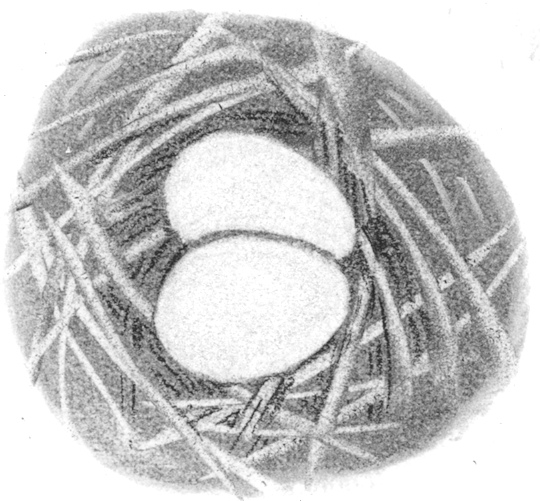
A mourning dove burst whistling from a clump of snakeweed. I thought, Hmm! Sure enough, there was her nest on the stony earth: round, shaped from dry grasses. Two exquisite white eggs in it, the newest things I’ve ever seen.

*

The Coyote Classic…Almost

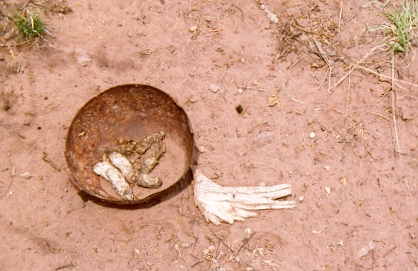
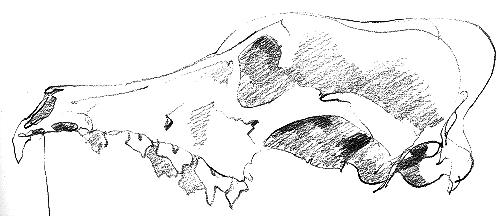
A yearling coyote had tried to leap a rusty fence, caught its hind leg and now hung upside down, dead. In an attempt to free itself it had indeed gnawed off its foot—but in the wrong place, the far rather than the near side of the entrapping wire.

The leg bones protruded from the poor, chewed stump. In what would soon be a clean skull, its teeth were very white.

*

Lost and Found

Bushwhacking in the dense piñon-juniper and oak brush that covered the mesa, on a windy day that obscured all sound. I was newly aware of how one tracks companions by constant, quick glances through the twiggage, near-subliminal glimpses every four to eight seconds: a scrap of color, a blink of movement out of place against the moving background. It’s an almost-unconscious art, and takes practice. First we lost Rob, then Gary, then John.

They all straggled in later at the car, remarking on how, in countryside like this, a group can get separated in less than a minute. Their shouts had been inaudible in the wind.

One Up on Jesus

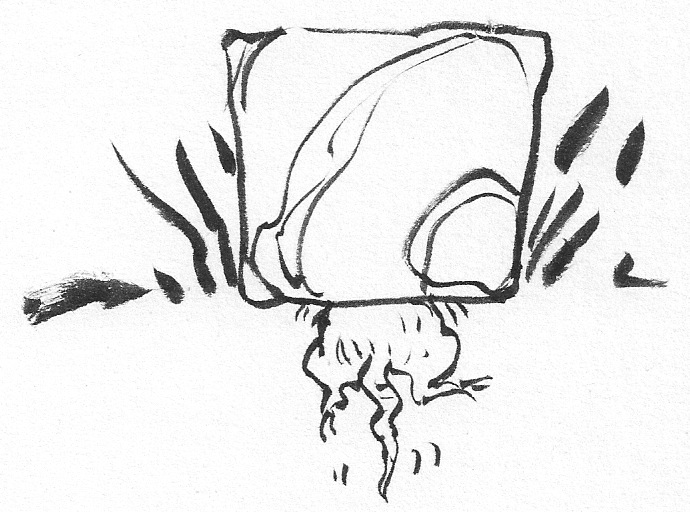
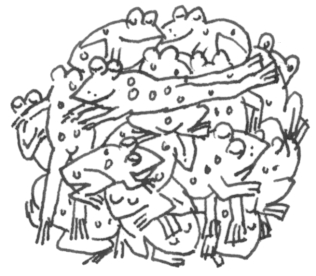
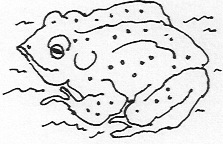
The big stock pond where we parked at the edge of the wilderness was desert-dry. Jan recalled hiking there after the monsoon, when there were so many frogs you could hear them two miles away. He said, “Dug in under that dirt are a hundred thousand frogs, waiting for rain.”

On our way back we crossed the pond’s dry bed, walking on thousands of frogs.

*

Serpentine Curves

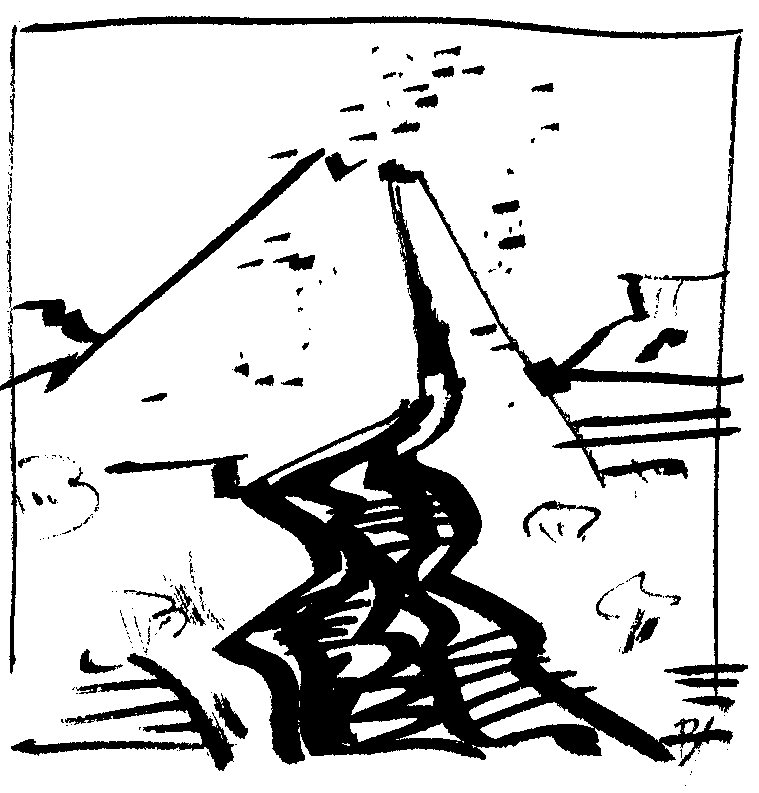
Hiking the canyon of the  Rio Santa Fe, over our heads the stone-cribbed hairpin turns that carried Spanish wagons, Civil War soldiers and Model Ts up this section of the Camino Real. The eroding pale strata of the canyon walls were capped by tumbled, slightly columnar basalt.

At the cliffs’ feet the rio’s busy water looped and twinkled. It smelled chemical; it was runoff from Santa Fe’s sewage treatment plant, equal parts groundwater from Buckman Wells and bottled water from Fiji that had been filtered through wealthy Santa Feans. Winding down that river was, no doubt, a lot of cocaine.

In the sedge at the brink I nearly stepped on a bull snake. We left, abruptly, in opposite directions.

*

Winter

On the east ridge, looking east. Still a slight afterglow on the wrinkled, stratified, bitten and convoluted land. The snowy Ortiz rising above the mesas like ice; far away, the Sangre de Cristo peaks white, turning blue, and nothing, nothing, nothing human visible but two tiny lights, distant, almost to Santa Fe.

*

No Doubt

At Zuni: We borrowed a clutch of neighbor kids and went hiking in the windblown sand south of the pueblo. The kids were itchy and wild, flinging themselves off the red dunes, playing cowboys and Indians—funny, given that they were all Indians.

One of the adults, a fast hiker, disappeared for awhile. We wondered aloud, “Where’s Andy?” Small Brandon said seriously, “Prob’ly those Indians got him.”

*

Litter

Besides its many miles, the best part of the hike was a lonely homestead perched on a rise in the sandstone. For the backcountry, where until the late 1860s Navajo raids made life unhealthy, this settlement was very early. Not even the shape of the house was left, just a heap of stones, but the trash—! Purple glass and thick white china reduced to confetti, buttons, shreds of wire, squashed Prince Albert tobacco cans and unrecognizable bits of rusty metal were scattered over acres.

It was support for my theory that early settlers, uneasy in the wilderness, liked to look at their civilized garbage.

*

The One Who Stayed

Far back on a badlands hillside, we came upon a crude corral and, to our surprise, a grave. Man-sized, oriented east-west and probably shallow, because limestone slabs had been laid densely and on edge to prevent coyotes from digging.

The site overlooked a trade and travel route in the valley. We wondered about this death. Illness? Indians? A cowboy, a shepherd, a traveler? Such a lonely place.

The land was bare, long ago grazed to gravel. In raking winter light the hillside was corrugated with grazing trails, here and there a hummock of grama to hint that all had once been grassland.  Limestone bedrock: shoe-eating, hand-ripping, home now of ocotillo and creosote bush, with sparse juniper and piñon growing along washes that were relics of wetter times.

A harsh land. Not many humans ever lived there. But one died there.