In a little clearing lay the perfectly articulated skeleton of a coyote, probably winter-killed. The skull with its gleaming teeth had been picked white and clean, but a bit of hide and sand-colored fur still clung to the delicate bones of one paw.
All posts by Betsy James
Caught Knapping
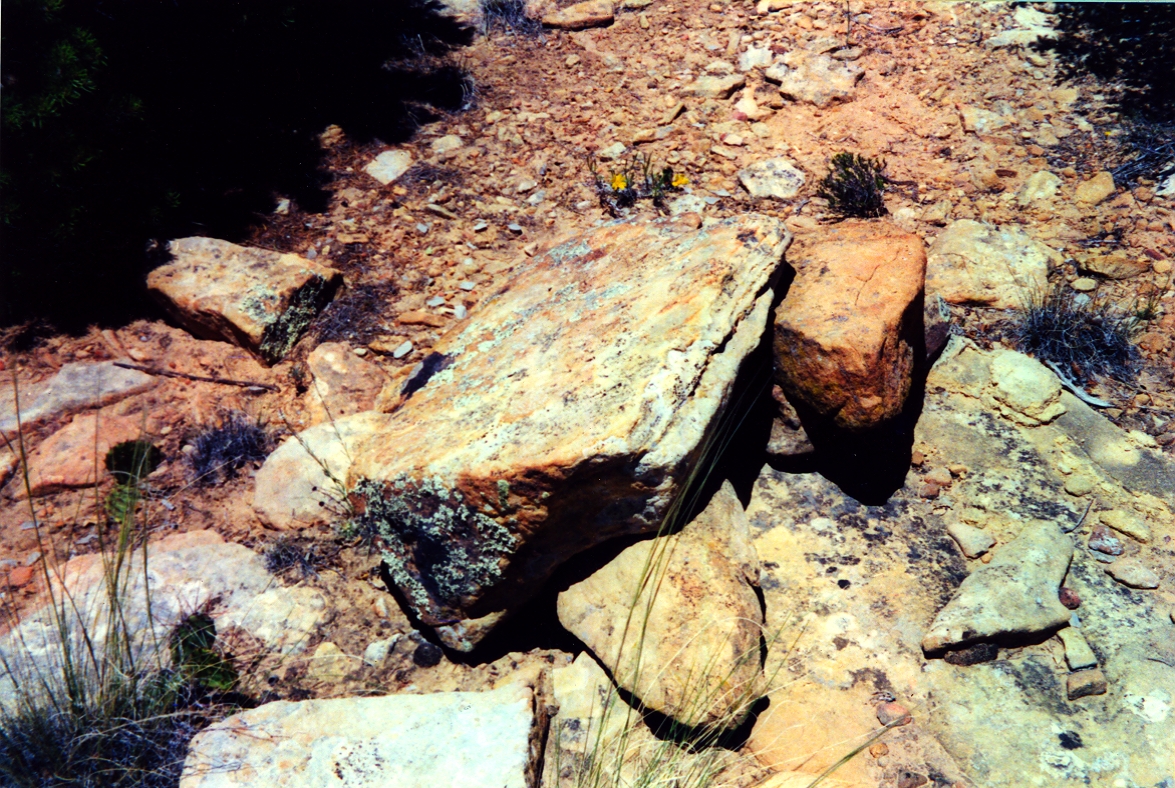
A flint knapper’s site. Flakes everywhere, all from the same crystalline quartzite core. The knapper had built himself a seat by propping a sandstone slab against two smaller rocks. Bill said he must have been an old guy with arthritis who had to get his chair just right.
To me the site seemed recent, say 300-500 years old: the slab had not toppled, the flakes had traveled only about thirty feet down the slope. But the quartzite was typically Archaic, which would put it back a thousand years at least. Possibly much more.
Hidden Honey
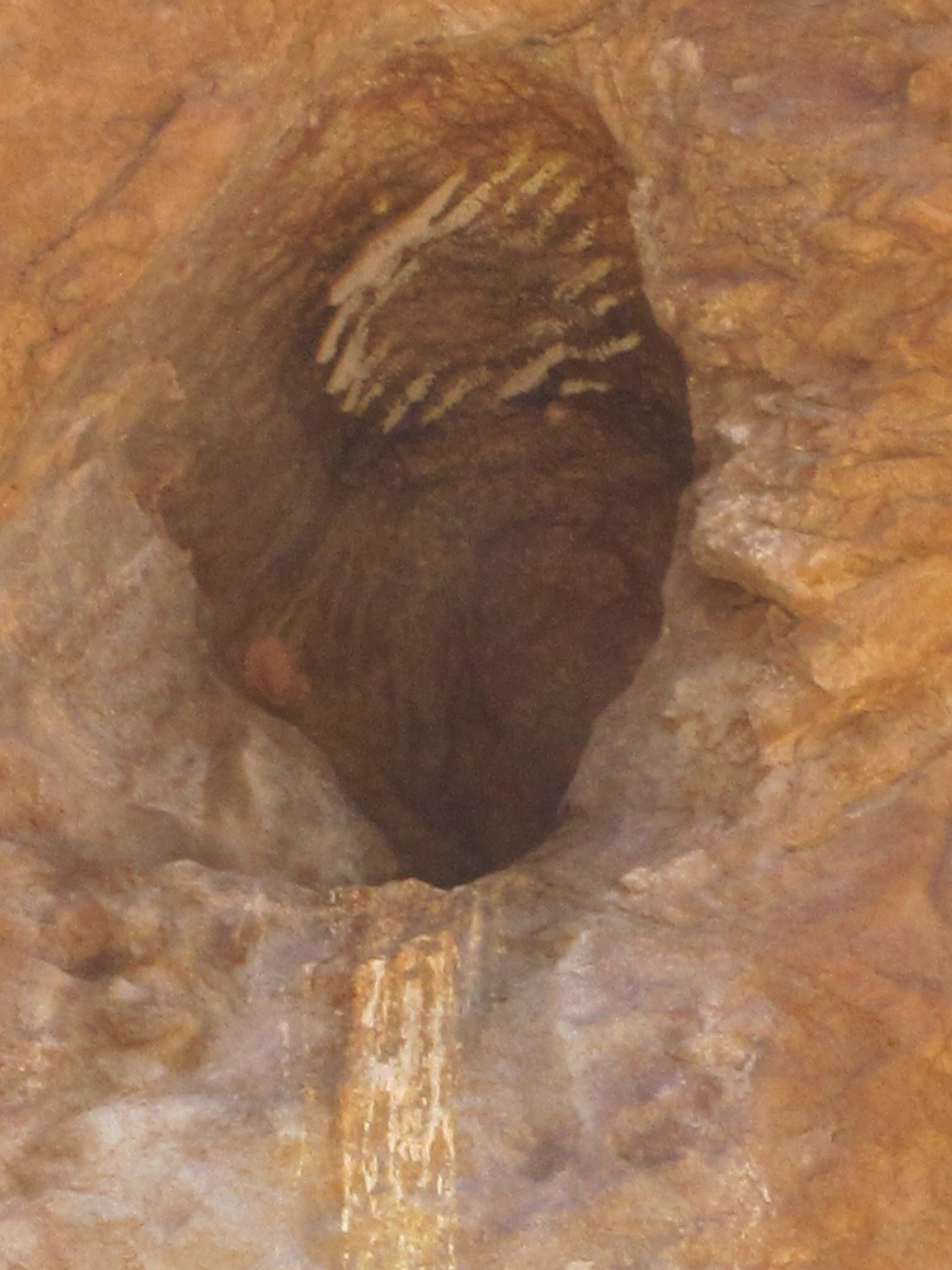
The dry stream bed we followed left the sandstone and entered a twisted granite canyon, narrow and deep-shaded. A barn owl startled and flew, soft clop of wings. High on the canyonside was its nest hole, the entryway streaked with mutes. Striations on the roof of it were the weathered wattles of a wild beehive, the remaining honey cells like waxy lace.
That hive was abandoned. But when we dug at a damp place in the sand, water welled up and thirsty bees came clustering. Somewhere in that canyon there is a hidden hive.
Visions
From the western ridge of the syncline a pass looks out over Cabezón, shadowy and shadow-washed. Many ancient, rudimentary stone circles scatter their boulders on high points. Each may be the site of a vision quest; we can think of no other explanation. Below lie mineral springs. One is raised on its deposits, a breast whose nipple is a pool, perfectly round, green as an old penny.
As we walked back along the ridge, some small creature far down among the split rocks screamed at us: Squee! Squee! Squee! An ear-splitting insult that never stopped until we went away.
In Just Spring
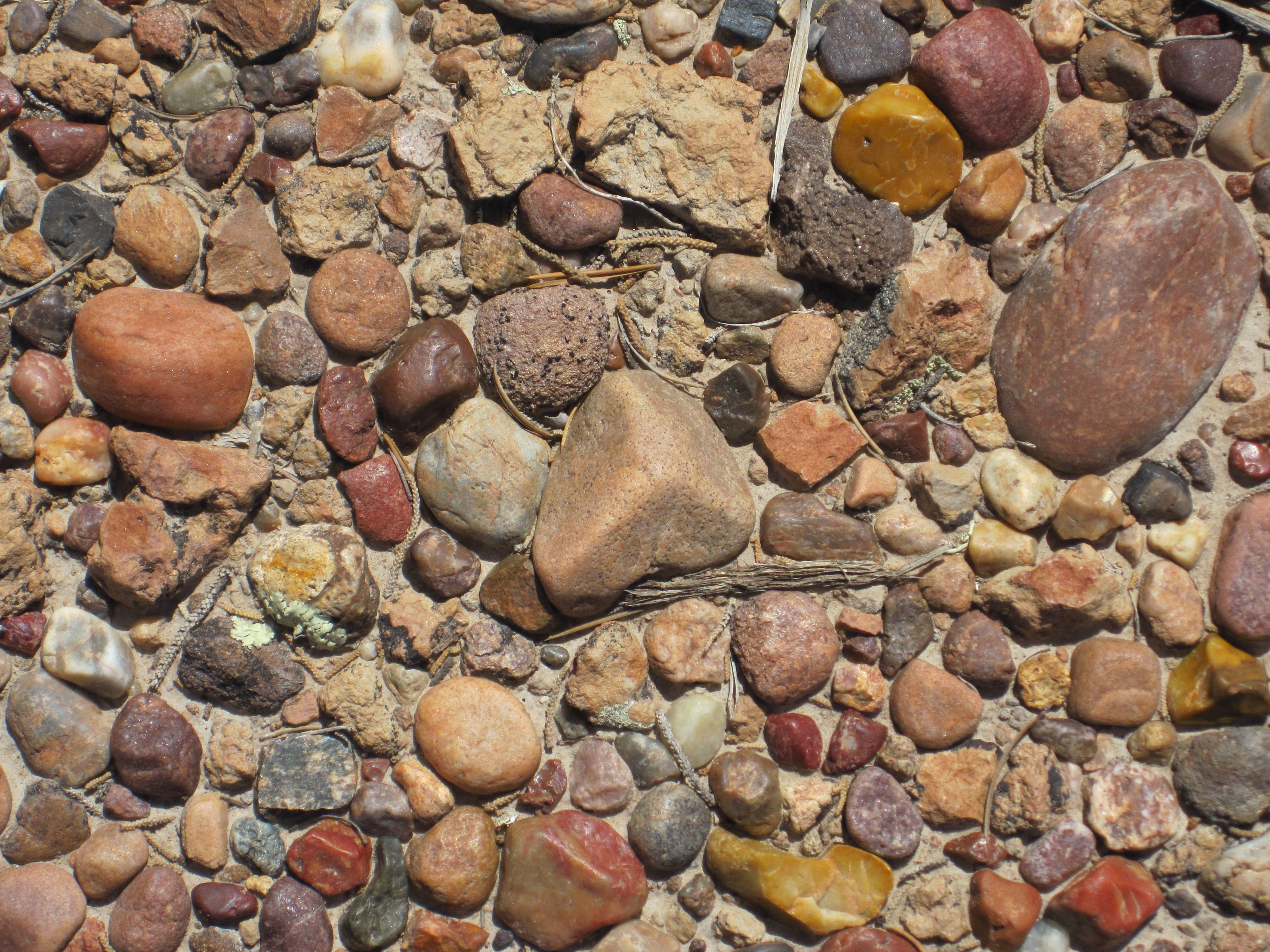
A tiny harlequein horned toad with reddish body, gray legs and stripy gray tail. Was it so variegated because it lived among multicolored gravels? It was barely the size of a quarter.
Later in the day we came upon truly horny horned toads, a mating pair. The female was fat and tan, the male slender and ash-colored. When we came close to look they fled, but they fled together. The male, even in fear, followed the female and would not lose her.
Red
Red Mesa. The redness of the rock, and of the plants as well. Even the grass is red at the base. Perhaps that’s just the color it is—it might be Little Bluestem, such a contradictory name—or maybe it picks up the iron in the soil. Tracts of red sandstone are covered—covered—with knobby, black, marble-size concretions.
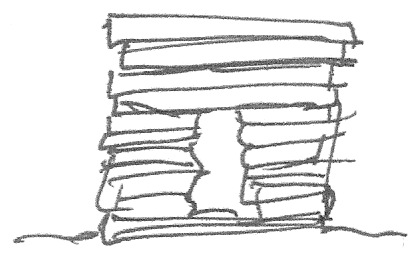
At the edge of the rugged canyon is a sheepherder’s monument, a two-legged stack of red sandstone reminiscent of an Inuit inuksuk. Old cairns mark the sheep trail down into the barranca.
Three big red potsherds lie where a pot was dropped, hundreds of years ago.
*
Realism
On a promontory, a huge Archaic campsite. People had slept in that sandy hollow for millennia, for it was black with firepits, and at times it must have been a trash heap. But Archaic trash, unlike our own, was nothing: the husks of wild grasses scattered by the wind, the femur of a mountain sheep smashed for the marrow, a few human turds.
Halfway down the steep canyonside, irrevocably stuck, abandoned and stripped, was the shell of a vehicle of the species we call a “poodle jeep”: iridescent green, with graphics. Somebody thought that advertisement was real.
Ever Deeper into Time
To the Syncline, where we watched a pair of ravens build their nest. Among the braided channels of the arroyo was a beautiful Archaic metate—a smoothly pecked, scooped-out bowl in the bedrock, say two thousand years old.
As we scrambled a rocky side canyon I came upon a desert-varnished boulder with the impression of three ferns, tidy as a museum exhibit. Probably Triassic: more than two million years. Later I went back to look for it. I found the ravens’ nest, but the ferns were lost among the trillion stones of the canyonside.
Unforced
Penistaja Mesa, tohellandgone west of Cuba. Cabezón dim and blue on the horizon. Tertiary strata, sometimes black with almost-coal. Everywhere petrified wood: enormous whole logs weathering into chips, as though we walked through slash left by a mad stone woodcutter.
Penistaja is probably a corruption of the Navajo binishdaahi’, “I forced him to sit.” So we sat.
Mud and Invisibility
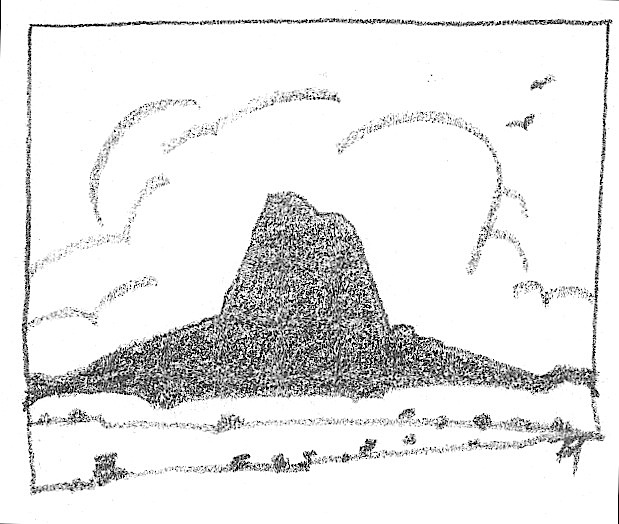
Hidden Mountain on the Puerco. Crossed the sedgy wash in bare feet because the Chinle red mud stuck like glue and gooshed up between my toes. Tried to clean my feet with snow, sand, paper towels. Useless! Had to use precious water from my canteen. My hiking partner, who tried to cross without taking his boots off, did a Three Stooges pratfall smack in the mud.
All along the hogback there are sulphurous spring deposits. One is a breast, the nipple a round pool a handspan wide where cold water bubbles up.
All of this is perfectly visible from Amtrak. I’ve ridden Amtrak. Never noticed.