All posts by Betsy James

Raptor Day

On the San Luis road, a family of bald eagles on the plains west of the road, eating something: two adults, three juveniles. They rose lazily, the sun flashing on the adults’ white heads, and settled again farther away. They looked as big as sheep.

Hours later we left on the same road. A little marsh hawk came skimming along above the fences. Then a big, moth-eaten redtail sat on a telephone wire, sick or in molt. I stopped the truck right underneath it. It looked at me over its shoulder, lifted its tail to show its fluffy vent, and shat. Missed me.

Boots

Boots Syncline Snow

Silence, Sound

On the Dinetah. A long, bright canyon ruined with pump stations and the smell of gas.  A four-point buck bounded away with noiseless leaps; it stopped on the far side of the wash and looked at me.

Doug said the spacing of hogans in a historic Navajo dwelling cluster is “shouting distance”: a son-in-law may not see his mother-in-law, yet family groups must communicate. He demonstrated this by shrieking, mother-in-lawishly, “Dor-eeeen!

Boots

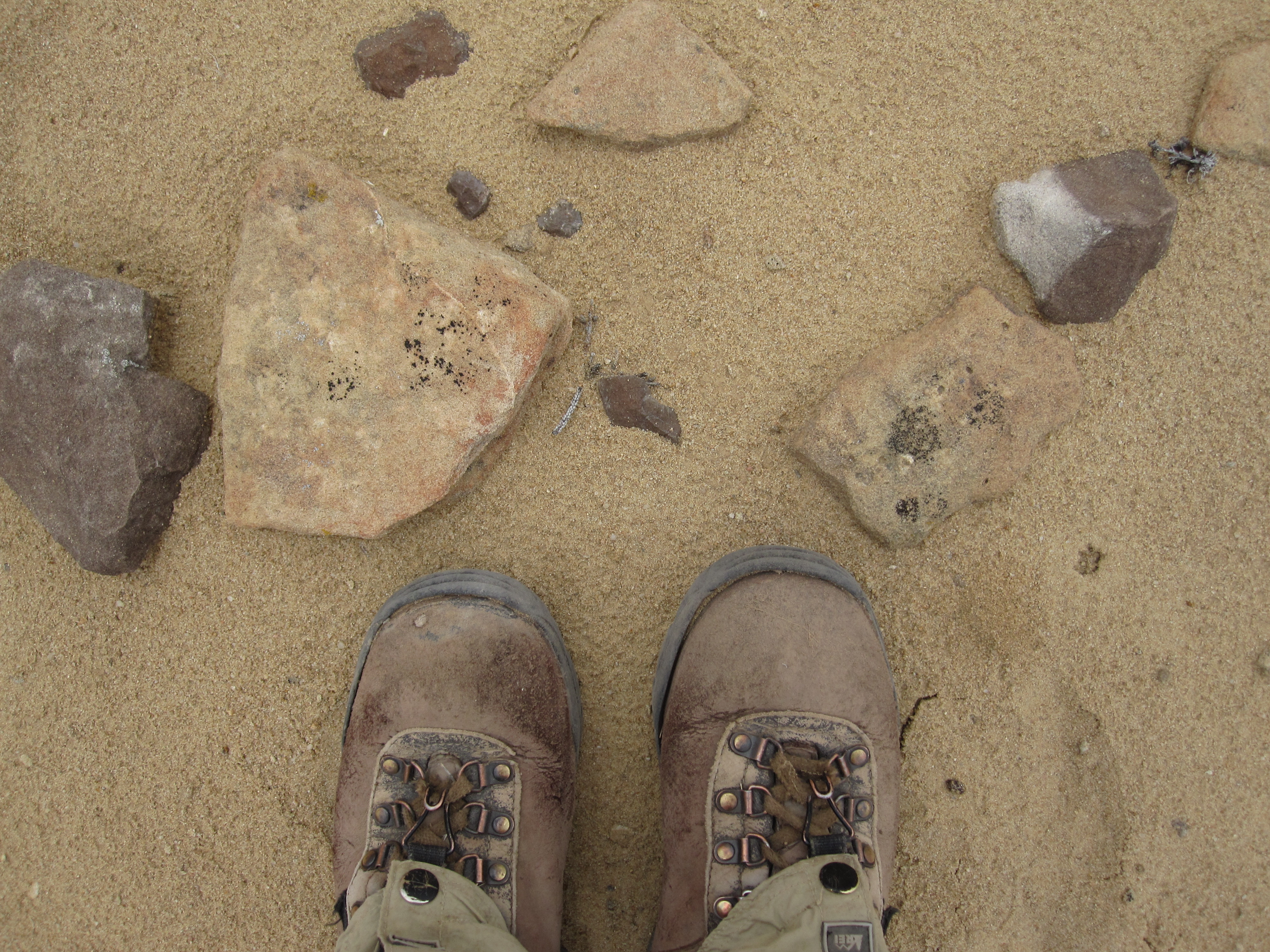
Boots Sand copy


Yo Ho Ho

We parked not far from an old rancho, and spent the day trudging up and down gravel hills. The bigger chert cobbles had been “mined” for the knapping of projectile points: busted cores, anvils, and hammer stones.

And rum bottles. Some cowboy was a rum drinker. We found bottles of every brand, broadcast as if by a man on horseback. And one lonely shot glass.

Boots

Boots Cebolla barbwire

And Then the Rains Came

I discovered my poncho wasn’t waterproof any more.

It shed most of the water mechanically, so I wore it tied at my neck like a Superman cape. The rain pissed down. We were soaked to the thighs, but the wind was at our backs. When we’d slogged back to the truck—it took a couple of hours—we were so wet that when I lifted my feet to the pedals, water rushed to the backs of my boots.

*****

Boots

Boots Ojito Sand & Rocks


Baa, Baa, Fat Sheep

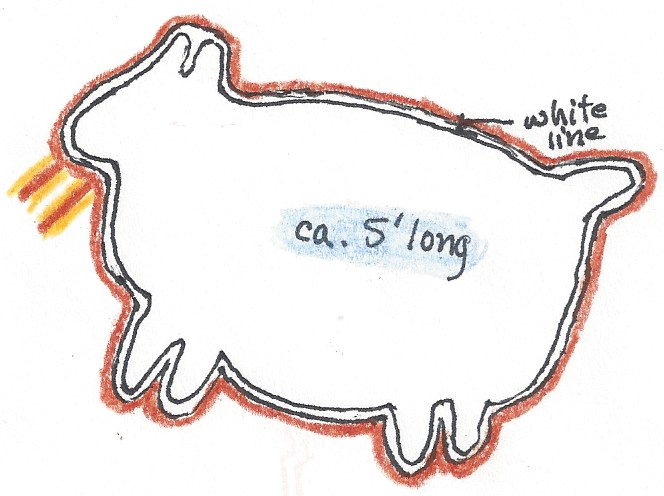
Mt Sheep? pictographUnder the overhang of a rock shelter was a pictograph that reminded me of a marrano, the pudgy gingerbread pig you can buy in every good Mexican bakery. For the (pigless and gingerless) pre-Columbian artist this may have represented a mountain sheep. It had been drawn in white, presumably gypsum, and outlined in red ochre. Each “slash” at the head was framed with yellow ochre.

I roamed off to snoop around a promontory over the creek, a flat expanse of red sandstone. Though there was a fallen, turn-of-the-century Hispanic ruin just west of it, the place felt untouched since earth’s morning. So quiet, so scoured by water and time—only flowers and the bending grass.

Living Gold

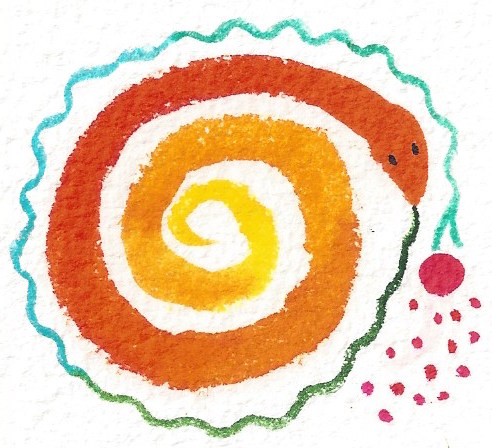
Yellow snakeIn the sandpits of a big Archaic site we came upon a golden bull snake, thick-bodied, almost six feet long. We approached it cautiously. It did not move except to flick its black tongue, smelling us.

When we had looked at it long enough, we spoke and moved more normally. It wove toward us, aggressing; then gracefully, unhurriedly, it turned along its body and slipped back into the brush. For all its length and girth it left scarcely any mark in the sand.

Do Not Litter

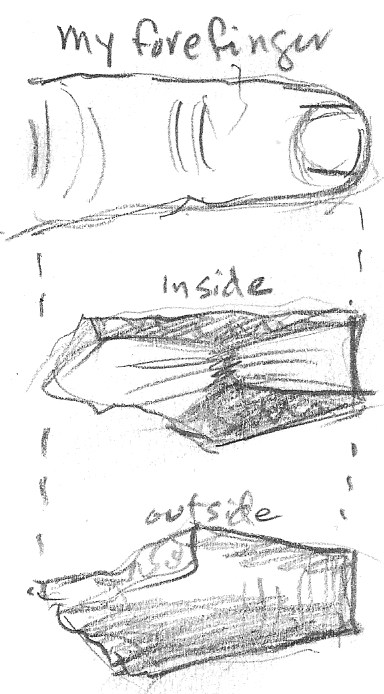
Pipe fragment?I get cranky about trash in the wilderness. At the foot of the low mesa I picked up what I thought was a fragment of gray plastic hose.

It was the broken mouthpiece of a Puebloan tobacco pipe, conically drilled from either end and polished quite round. (That’s a field drawing, with my not-very-big forefinger for scale. Say an inch and some.) Probably argillite, which is “indurated claystone”: claystone that was heated and hardened underground by, for example, a volcanic dike.

I thought of 14th Century men huddled in the lee of the mesa, having a—probably ceremonial—smoke.

Reality, Comma, Various Aspects of

Mesas DB241We followed the water-scoured sandstone channels until they petered out, then crossed to the next gully west. This ended in a series of tinajas and a plunge pool. We crawled up to a rock shelter above—charcoal and sherds and rat poop—and clambered down to a second, even lovelier set of pools. There we put our backs against the stone and listened to the ponderosa sigh. Most beautiful tree, the ponderosa. Most beautiful voice, the peaceful tree.

In the midst of this communion with nature G. discovered that a thermos of coffee—cream and sugar—had come open in his pack.

Rock Happy

Basket of Rocks 2A frosty desert morning on the gravels of the ancient Rio Puerco. All around us, distantly, the pop and crack of target shooting. We parked in a trashed pullout and hiked away from the road.

Wandering, sometimes talking, sometimes silent, we picked up rocks and dropped them. Showed each other the best ones: quartz and quartzites,  petrified wood, metamorphics full of crinoid stems—all tumble-polished millions of years before humans were human. The sun rose, then sank. The wide bare plains; the weather-bitten volcanic Ladrones palely looming, almost floating. Except for wind and the marksmen, silence.

At dusk, our pockets full of pretty rocks, we trailed back to the pickup and sat on the tailgate as the target shooters drove homeward past us in their four-by-fours.

Deep Thoughts

Mountain&Canyon 1We followed the ridge for a while, then dropped into the dry gorge. Seasonal flash floods had carved an amphitheater, huge, cool, and dim. The east rim, where the low sun struck, was brilliant yellow against the cobalt sky.

The floods had rolled big stones around and around until they drilled deep holes into the bedrock. One shaft was nine feet deep. How many millennia of intermittent rains does it take to scour a pit like that?